In quantum information theory, the Wehrl entropy,[1] named after Alfred Wehrl, is a classical entropy of a quantum-mechanical density matrix. It is a type of quasi-entropy defined for the Husimi Q representation of the phase-space quasiprobability distribution. See [2] for a comprehensive review of basic properties of classical, quantum and Wehrl entropies, and their implications in statistical mechanics.
Definitions
The Husimi function[3] is a "classical phase-space" function of position x and momentum p, and in one dimension is defined for any quantum-mechanical density matrix ρ by

where φ is a "(Glauber) coherent state", given by

(It can be understood as the Weierstrass transform of the Wigner quasi-probability distribution.)
The Wehrl entropy is then defined as

The definition can be easily generalized to any finite dimension.
Properties
Such a definition of the entropy relies on the fact that the Husimi Q representation remains non-negative definite,[4] unlike other representations of quantum quasiprobability distributions in phase space. The Wehrl entropy has several important properties:
- It is always positive,
like the full quantum von Neumann entropy, but unlike the classical differential entropy which can be negative at low temperature. In fact, the minimum value of the Wehrl entropy is 1, i.e.
as discussed below in the section "Werhl's conjecture".
- The entropy for the tensor product of two systems is always greater than the entropy of one system. In other words, for a state
on a Hilbert space
, we have
, where
. Note that the quantum von Neumann entropy,
, does not have this property, as can be clearly seen for a pure maximally entangled state.
- The Wehrl entropy is strictly lower bounded by a von Neumann entropy,
. There is no known upper or lower bound (other than zero) for the difference
.
- The Wehrl entropy is not invariant under all unitary transformations, unlike the von Neumann entropy. In other words,
for a general unitary U. It is, however, invariant under certain unitary transformations.[1]
Wehrl's conjecture
In his original paper [1] Wehrl posted a conjecture that the smallest possible value of Wehrl entropy is 1, 
.
Soon after the conjecture was posted, E. H. Lieb proved [5] that the minimum of the Wehrl entropy is 1, and it occurs when the state is a projector onto any coherent state.
In 1991 E. Carlen proved [6] the uniqueness of the minimizer, i.e. the minimum of the Wehrl entropy occurs only when the state is a projector onto any coherent state.
The analog of the Wehrl conjecture for systems with a classical phase space isomorphic to the sphere (rather than the plane) is the Lieb conjecture.
Discussion
However, it is not the fully quantum von Neumann entropy in the Husimi representation in phase space, − ∫ Q ★ log★Q dx dp: all the requisite star-products ★ in that entropy have been dropped here. In the Husimi representation, the star products read

and are isomorphic[7] to the Moyal products of the Wigner–Weyl representation.
The Wehrl entropy, then, may be thought of as a type of heuristic semiclassical approximation to the full quantum von Neumann entropy, since it retains some ħ dependence (through Q) but not all of it.
Like all entropies, it reflects some measure of non-localization,[8] as the Gauss transform involved in generating Q and the sacrifice of the star operators have effectively discarded information. In general, as indicated, for the same state, the Wehrl entropy exceeds the von Neumann entropy (which vanishes for pure states).
Wehrl entropy for Bloch coherent states
Wehrl entropy can be defined for other kinds of coherent states. For example, it can be defined for Bloch coherent states, that is, for angular momentum representations of the group 
Bloch coherent states
Consider a space 
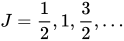

![{\displaystyle [S_{x},S_{y}]=i\,S_{z}}](https://wikimedia.org/api/rest_v1/media/math/render/svg/fe2d2416316ae7d79d891cdafadd5d642ec96f0f)
Define 
![{\displaystyle [S_{z},S_{\pm }]=\pm S_{\pm }}](https://wikimedia.org/api/rest_v1/media/math/render/svg/2c7aea1a07ae8b8efc2881050fe56254300ca1f4)
![{\displaystyle [S_{+},S_{-}]=S_{z}}](https://wikimedia.org/api/rest_v1/media/math/render/svg/737acf0b29984c06d41d970e67548b12347fe629)
The eigenstates of 

For 

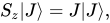

Denote the unit sphere in three dimensions by
,
and by 
.
The Bloch coherent state is defined by
.
Taking into account the above properties of the state 

where 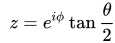

is a normalised eigenstate of 
The Bloch coherent state is an eigenstate of the rotated angular momentum operator
,
the Bloch coherent state 
.
Wehrl entropy for Bloch coherent states
Given a density matrix ρ, define the semi-classical density distribution
.
The Wehrl entropy of 
,
where 
Wehrl's conjecture for Bloch coherent states
The analogue of the Wehrl's conjecture for Bloch coherent states was proposed in [5] in 1978. It suggests the minimum value of the Werhl entropy for Bloch coherent states,
,
and states that the minimum is reached if and only if the state is a pure Bloch coherent state.
In 2012 E. H. Lieb and J. P. Solovej proved [9] a substantial part of this conjecture, confirming the minimum value of the Wehrl entropy for Bloch coherent states, and the fact that it is reached for any pure Bloch coherent state. The problem of the uniqueness of the minimizer remains unresolved.
Generalized Wehrl's conjecture
In [9] E. H. Lieb and J. P. Solovej proved Wehrl's conjecture for Bloch coherent states by generalizing it in the following manner.
Generalized Wehrl's conjecture
For any concave function ![{\displaystyle f:[0,1]\rightarrow \mathbb {R} }](https://wikimedia.org/api/rest_v1/media/math/render/svg/29d08e15410d8d326f4ee95edfa4816f4794cf2c)

,
where ρ0 is a pure coherent state defined in the section "Wehrl conjecture".
Generalized Wehrl's conjecture for Bloch coherent states
Generalized Wehrl's conjecture for Glauber coherent states was proved as a consequence of the similar statement for Bloch coherent states. For any concave function
,
where 
The uniqueness of the minimizers for either statement remains an open problem.
| This article uses material from the Wikipedia article Metasyntactic variable, which is released under the Creative Commons Attribution-ShareAlike 3.0 Unported License. |