In mathematics, Topological recursion is a recursive definition of invariants of spectral curves. It has applications in enumerative geometry, random matrix theory, mathematical physics, string theory, knot theory.
IntroductionEditThe topological recursion is a construction in algebraic geometry.[1] It takes as initial data a spectral curve: the data of  , where:
  is a covering of Riemann surfaces with ramification points;
  is a meromorphic differential 1-form on
  , regular at the ramification points;
  is a symmetric meromorphic bilinear differential form on
  having a double pole on the diagonal and no residue.
The topological recursion is then a recursive definition of infinite sequences of symmetric meromorphic n-forms  on
on  , with poles at ramification points only, for integers g≥0 such that 2g-2+n>0. The definition is a recursion on the integer 2g-2+n.
In many applications, the n-form is interpreted as a generating function that measures a set of surfaces of genus g and with n boundaries. The recursion is on 2-2g-n the Euler characteristics, whence the name "topological recursion".

Schematic illustration of the topological recursion: recursively adding pairs of pants to build a surface of genus g with n boundaries
The topological recursion was first discovered in random matrices. One main goal of random matrix theory, is to find the large size asymptotic expansion of n-point correlation functions, and in some suitable cases, the asymptotic expansion takes the form of a power series. The n-form is then the gth coefficient in the asymptotic expansion of the n-point correlation function. It was found[2][3][4] that the coefficients always obey a same recursion on 2g-2+n. The idea to consider this universal recursion relation beyond random matrix theory, and to promote it as a definition of algebraic curves invariants, occurred in Eynard-Orantin 2007[1] who studied the main properties of those invariants.
An important application of topological recursion was to Gromov-Witten invariants. Marino and BKMP[5] conjectured that Gromov-Witten invariants of a toric Calabi-Yau 3-fold  are the TR invariants of a spectral curve that is the mirror of .
Since then, topological recursion has generated a lot of activity in particular in enumerative geometry. The link to Givental formalism and Frobenius manifolds has been established.[6]
DefinitionEdit(Case of simple branch points. For higher order branchpoints, see the section Higher order ramifications below)
- For
 and
and  :
:

where  is called the recursion kernel: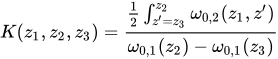
and  is the local Galois involution near a branch point
  , it is such that
  . The primed sum
  means excluding the two terms
  and
and  .
.
- For
 and
and  :
:

with  any antiderivative of .
- The definition of
 and
and  is more involved and can be found in the original article of Eynard-Orantin.[1]
Main propertiesEdit- Symmetry: each is a symmetric
 -form on .
 - poles: each is meromorphic, it has poles only at branchpoints, with vanishing residues.
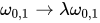
- Homogeneity: is homogeneous of degree
 . Under the change
  , we have
  .
. - Dilaton equation:

where .
- Loop equations: The following forms have no poles at branchpoints
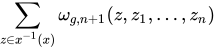
 where the sum has no prime, i.e. no term excluded.
- Deformations: The satisfy deformation equations
- Limits: given a family of spectral curves
 , whose limit as
  is a singular curve, resolved by rescaling by a power of
  , then
  .
. - Symplectic invariance: In the case where is a compact algebraic curve with a marking of a symplectic basis of cycles,
 is meromorphic and
  is meromorphic and
  is the fundamental second kind differential normalized on the marking, then the spectral curve
  and
and  , have the same
  shifted by some terms.
 - Modular properties: In the case where is a compact algebraic curve with a marking of a symplectic basis of cycles, and is the fundamental second kind differential normalized on the marking, then the invariants are quasi-modular forms under the modular group of marking changes. The invariants satisfy BCOV equations.
GeneralizationsEditHigher order ramificationsEdit
In case the branchpoints are not simple, the definition is amended as follows[7] (simple branchpoints correspond to k=2):

The first sum is over partitions  of
of  with non empty parts
  , and in the second sum, the prime means excluding all terms such that
  .
.
 is called the recursion kernel:

The base point * of the integral in the numerator can be chosen arbitrarily in a vicinity of the branchpoint, the invariants will not depend on it.
Topological recursion invariants and intersection numbersEditThe invariants can be written in terms of intersection numbers of tautological classes
- [8]
(*) 
where the sum is over dual graphs of stable nodal Riemann surfaces of total arithmetic genus  , and smooth labeled marked points
  , and equipped with a map
  .
.  is the Chern class of the cotangent line bundle
  whose fiber is the cotangent plane at
  .
.  is the
  th Mumford's kappa class. The coefficients
  ,
,  ,
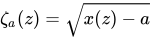
,  , are the Taylor expansion coefficients of and in the vicinity of branchpoints as follows: in the vicinity of a branchpoint (assumed simple), a local coordinate is
  . The Taylor expansion of
  near branchpoints
  ,
,  defines the coefficients
 .
.
The Taylor expansion at  , defines the 1-forms coefficients
 whose Taylor expansion near a branchpoint
  is
is
 .
.
Write also the Taylor expansion of
 .
.
Equivalently, the coefficients  can be found from expansion coefficients of the Laplace transform, and the coefficients are the expansion coefficients of the log of the Laplace transform
 .
.
For example, we have


The formula (*) generalizes ELSV formula as well as Mumford's formula and Mariño-Vafa formula.
Some applications in enumerative geometryEditMirzakhani's recursionEdit
M. Mirzakhani's recursion for hyperbolic volumes of moduli spaces is an instance of topological recursion. For the choice of spectral curve 
the n-form  is the Laplace transform of the Weil-Petersson volume

where  is the moduli space of hyperbolic surfaces of genus g with n geodesic boundaries of respective lengths
  , and
, and  is the Weil-Petersson volume form.
The topological recursion for the n-forms  , is then equivalent to Mirzakhani's recursion.
Witten-Kontsevich intersection numbersEdit
For the choice of spectral curve 
the n-form is

where  is the Witten-Kontsevich intersection number of Chern classes of cotangent line bundles in the compactified moduli space of Riemann surfaces of genus g with n smooth marked points.
Hurwitz numbersEdit
For the choice of spectral curve 
the n-form is

where  is the connected simple Hurwitz number of genus g with ramification
  : the number of branch covers of the Riemann sphere by a genus g connected surface, with 2g-2+n simple ramification points, and one point with ramification profile given by the partition
  .
.
Gromov-Witten numbers and the BKMP conjectureEdit
Let a toric Calabi-Yau 3-fold, with Kähler moduli  . Its mirror manifold is singular over a complex plane curve given by a polynomial equation
 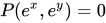 , whose coefficients are functions of the Kähler moduli. For the choice of spectral curve
  with the fundamental second kind differential on ,
According to the BKMP[5] conjecture, the n-form is

where ![{\displaystyle {\mathcal {N}}_{g}({\mathfrak {X}},{\mathcal {L}};\mathbf {d} ,\mu _{1},\dots ,\mu _{n})=\int _{[{\overline {\mathcal {M}}}_{g,n}({\mathfrak {X}},{\mathcal {L}},\mathbf {d} ,\mu _{1},\dots ,\mu _{n})]^{\rm {vir}}}1}](https://wikimedia.org/api/rest_v1/media/math/render/svg/586526d7cefbf4f18e30704224c78008743b4ab1)
is the genus g Gromov-Witten number, representing the number of holomorphic maps of a surface of genus g into , with n boundaries mapped to a special Lagrangian submanifold  .
.  is the 2nd relative homology class of the surface's image, and
 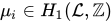 are homology classes (winding number) of the boundary images.
The BKMP[5] conjecture has since then been proven.