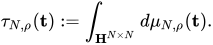
Tau functions are an important ingredient in the modern theory of integrable systems, and have numerous applications in a variety of other domains. They were originally introduced by Ryogo Hirota [1] in his direct method approach to soliton equations, based on expressing them in an equivalent bilinear form. The term Tau function, or  -function, was first used systematically by Mikio Sato[2] and his students [3][4] in the specific context of the Kadomtsev–Petviashvili (or KP) equation, and related integrable hierarchies. It is a central ingredient in the theory of solitons. Tau functions also appear as matrix model partition functions in the spectral theory of Random Matrices, and may also serve as generating functions, in the sense of combinatorics and enumerative geometry, especially in relation to moduli spaces of Riemann surfaces, and enumeration of branched coverings, or so-called Hurwitz numbers.
Definition of -functionsEditThere are two notions of -functions, both introduced by the Sato school. The first is that of isomonodromic -functions .[5] The second is -functions of the Sato-Segal-Wilson type [2][6] for integrable hierarchies, such as the KP hierarchy, which are parametrized by linear operators satisfying isospectral deformation equations of Lax type.
A -function of isospectral type is a solution of the Hirota bilinear equations, from which the linear operator undergoing isospectral evolution can be uniquely reconstructed. Geometrically, in the Sato[2] and Segal-Wilson [6] sense, it is the value of the determinant of a Fredholm integral operator, interpreted as the orthogonal projection of an element of a suitably defined (infinite dimensional) Grassmann manifold onto the origin, as that element evolves under the linear exponential action of a maximal abelian subgroup of the general linear group. It typically arises as a partition function, in the sense of statistical mechanics, many-body quantum mechanics or quantum field theory, as the underlying measure undergoes a linear exponential deformation.
Hirota bilinear residue relation for KP -functionsEditA KP (Kadomtsev–Petviashvili) -function  is a function of an infinite number of KP flow variables
  that satisfies the following bilinear formal residue equation
![{\displaystyle \mathrm {res} _{z=0}\left(e^{\sum _{i=1}^{\infty }(\delta t_{i})z^{i}}\tau ({\bf {t}}-[z^{-1}])\tau ({\bf {s}}+[z^{-1}])\right)dz\equiv 0,}](https://wikimedia.org/api/rest_v1/media/math/render/svg/f3ba4bbd1b8eeec4e0d9f477ad7783416a1787d7) | | (1) |
identically in the  variables, where
  is the
  coefficient in the formal Laurent expansion resulting from expanding all factors as Laurent series' in
  , and
, and
![{\displaystyle {\bf {s}}:={\bf {t}}+(\delta t_{1},\delta t_{2},\cdots ),\quad [z^{-1}]:=(z^{-1},{\tfrac {z^{-2}}{2}},\cdots {\tfrac {z^{-j}}{j}},\cdots ).}](https://wikimedia.org/api/rest_v1/media/math/render/svg/330b050fd77785d40db7523f375596ebeaee1924)
Kadomtsev-Petviashvili equationEditIf  is a KP -function satisfying the Hirota residue equation (1) and we identify the first three flow variables as

it follows that the function

satisfies the  dimensional nonlinear partial differential equation
 | | (2) |
known as the Kadomtsev-Petviashvili (KP) equation, which plays a prominent role in plasma physics and in shallow water ocean waves.
Taking further logarithmic derivatives of gives an infinite sequence of functions that satisfy further systems of nonlinear autonomous PDE's, each involving partial derivatives of finite order with respect to a finite number of the KP flow parameters  . These are collectively known as the KP hierarchy.
Formal Baker-Akhiezer function and the KP hierarchyEditIf we define the (formal) Baker-Akhiezer function  by Sato's formula
![{\displaystyle \Psi (z,\mathbf {t} ):=e^{\sum _{i=1}^{\infty }t_{i}z^{i}}{\frac {\tau (\mathbf {t} -[z^{-1}])}{\tau (\mathbf {t} )}}}](https://wikimedia.org/api/rest_v1/media/math/render/svg/ee52bf245294d0d7829e0e091826af5336bd3c70)
and expand it as a formal series in the powers of the variable

this satisfies an infinite sequence of compatible evolution equations
 | | (3) |
where  is a linear ordinary differential operator of degree
  in the variable
  , with coefficients that are functions of the flow variables , defined as follows

where  is the formal pseudo-differential operator

with  , where
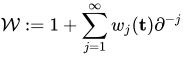
is the wave operator and  denotes the projection to the part of
  containing purely non-negative powers of
  ; i.e. to the differential operator part of .
The pseudodifferential operator satisfies the infinite system of isospectral deformation equations
![{\displaystyle {\frac {\partial {\mathcal {L}}}{\partial t_{i}}}=[{\mathcal {D}}_{i},{\mathcal {L}}],\quad i,=1,2,\dots }](https://wikimedia.org/api/rest_v1/media/math/render/svg/73f87b3548c0de96e1a3928e1bf987a5a155aece) | | (4) |
and the compatibility conditions for both the system (3) and (4) are
![{\displaystyle {\frac {\partial {\mathcal {D}}_{i}}{\partial t_{j}}}-{\frac {\partial {\mathcal {D}}_{j}}{\partial t_{i}}}+[{\mathcal {D}}_{i},{\mathcal {D}}_{j}]=0,\quad i,j,=1,2,\dots }](https://wikimedia.org/api/rest_v1/media/math/render/svg/fa2d756be15510c3e1811674f294a915297d95c6)
This is a compatible infinite system of nonlinear partial differential equations, known as the KP (Kadomtsev-Petviashvili) hierarchy, for the functions  , with respect to the set of independent variables, each of which contains only a finite number of
  's, and derivatives only with respect to the three independent variables
  . The first nontrivial case of these is the Kadomtsev-Petviashvili equation (2).
Thus, every KP function provides a solution, at least in the formal sense, of this infinite system of nonlinear partial differential equations.
Fuchsian isomonodromic systems: Isomonodromic -functionsEditConsider the overdetermined system of first order matrix partial differential equations
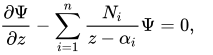 | | (5) |
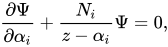 | | (6) |
where  are a set of
 traceless matrices,
  a set of complex parameters and a complex variable, and
  is an invertible matrix valued function of and . These are the necessary and sufficient conditions for the based monodromy representation of the fundamental group
  of the Riemann sphere punctured at the points corresponding to the rational covariant derivative operator
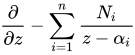
to be independent of the parameters ; i.e. that changes in these parameters induce an isomonodromic deformation. The compatibility conditions for this system are the Schlesinger equations [5]
![{\displaystyle {\partial N_{i} \over \partial \alpha _{j}}={[N_{i},N_{j}] \over \alpha _{i}-\alpha _{j}}\quad {\text{ for }}i\neq j,}](https://wikimedia.org/api/rest_v1/media/math/render/svg/d68d582906d42b24d8920daf77387a557e85bb75)
![{\displaystyle {\partial N_{i} \over \partial \alpha _{i}}=-\sum _{1\leq j\leq n,j\neq i}{[N_{i},N_{j}] \over \alpha _{i}-\alpha _{j}}.}](https://wikimedia.org/api/rest_v1/media/math/render/svg/3b0dc4f5a46aa59d30f27f1ef5c53eb6c670d083)
Defining the functions

the Schlesinger equations imply that the differential form
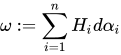
on the space of parameters is closed:

and hence, locally exact. Therefore, at least locally, there exists a function 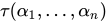 of the parameters, defined within a multiplicative constant, such that

The function is called the isomonodromic -function associated to the fundamental solution  of the system (5), (6). For non-Fuchsian systems, with higher order poles, the generalized monodromy data include Stokes parameters and connection matrices, and there are further isomonodromic deformation parameters associated with the local asymptotics, but the isomonodromic -functions may be defined in a similar way, using differentials on the extended parameter space.[5]
Fermionic VEV (vacuum expectation value) representationsEditThe fermionic Fock space  , is a semi-infinite exterior product space

defined on a (separable) Hilbert space  with basis elements
  and dual basis elements
  for
for  .
.
The free fermionic creation and annihilation operators  act as endomorphisms on via exterior and interior multiplication by the basis elements

and satisfy the canonical anti-commutation relations
![{\displaystyle [\psi _{i},\psi _{k}]_{+}=[\psi _{i}^{\dagger },\psi _{k}^{\dagger }]_{+}=0,\quad [\psi _{i},\psi _{k}^{\dagger }]_{+}=\delta _{ij}.}](https://wikimedia.org/api/rest_v1/media/math/render/svg/d6f5aa7f333ffedf85c9be0b9f5de209e7e12b33)
These generate the standard fermionic representation of the Clifford algebra on the direct sum  , corresponding to the scalar product

with the Fock space as irreducible module. Denote the vacuum state, in the zero fermionic charge sector  , as
, as
 ,
,
which corresponds to the Dirac sea of states along the real integer lattice in which all negative integer locations are occupied and all non-negative ones are empty.
This is annihilated by the following operators

The dual fermionic Fock space vacuum state, denoted  , is annihilated by the adjoint operators, acting to the left

Normal ordering  of a product of linear operators (i.e., finite or infinite linear combinations of creation and annihilation operators) is defined so that its vacuum expectation value (VEV) vanishes

In particular, for a product  of a pair
  of linear operators

The fermionic charge operator  is defined as
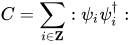
The subspace  is the eigenspace of consisting of all eigenvectors with eigenvalue
 .
.
The standard orthonormal basis  for the zero fermionic charge sector is labelled by integer partitions
  , where
  is a weakly decreasing sequence of
  positive integers, which can equivalently be represented by a Young diagram, as depicted here for the partition
  .
.

Young diagram of the partition (5, 4, 1)
An alternative notation for a partition  consists of the Frobenius indices
  , where
  denotes the arm length; i.e. the number
  of boxes in the Young diagram to the right of the 'th diagonal box,
  denotes the leg length, i.e. the number of boxes in the Young diagram below the 'th diagonal box, for
  , where
  is the Frobenius rank, which is the number of diagonal elements.
The basis element  is then given by acting on the vacuum with a product of pairs of creation and annihilation operators, labelled by the Frobenius indices

The integers  indicate, relative to the Dirac sea, the occupied non-negative sites on the integer lattice while
  indicate the unoccupied negative integer sites. The corresponding diagram, consisting of infinitely many occupied and unoccupied sites on the integer lattice that are a finite perturbation of the Dirac sea are referred to as a Maya diagram.[2]
The case of the null (emptyset) partition  gives the vacuum state, and the dual basis
  is defined by

Then any KP -function can be expressed as a sum
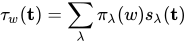
where  are the KP flow variables,
  is the Schur function corresponding to the partition , viewed as a function of the normalized power sum variables
![{\displaystyle t_{i}:=[\mathbf {x} ]_{i}:={\tfrac {1}{i}}\sum _{a=1}^{n}x_{a}^{i}\quad i=1,2,\dots }](https://wikimedia.org/api/rest_v1/media/math/render/svg/61be2a85470d3f5a11e4ba91d34b867aa348e813)
in terms of an auxiliary (finite or infinite) sequence of variables  and the constant coefficients
  may be viewed as the Plucker coordinates of an element
 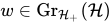 of the infinite dimensional Grassmannian consisting of the orbit, under the action of the general linear group
  , of the subspace
  of the Hilbert space .
This corresponds, under the Bose-Fermi correspondence, to a decomposable element
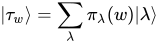
of the Fock space which, up to projectivization is the image of the Grassmannian element under the Plucker map
![{\displaystyle {\mathcal {Pl}}:\mathrm {span} (w_{1},w_{2},\dots )\longrightarrow [w_{1}\wedge w_{2}\wedge \cdots ]=[|\tau _{w}\rangle ],}](https://wikimedia.org/api/rest_v1/media/math/render/svg/c84fe30deec130337170733d6c26e8af6843687c)
where  is a basis for the subspace
  and
and ![{\displaystyle [\cdots ]}](https://wikimedia.org/api/rest_v1/media/math/render/svg/51cc669ab2e6cf8641bcb1c0fa1c283d463b21e4) denotes projectivization of an element of .
denotes projectivization of an element of .
The Plucker coordinates  satisfy an infinite set of bilinear relations, the Plucker relations, defining the Plücker embedding into the projecivization
  of the fermionic Fock space, which are equivalent to the Hirota bilinear residue relation (1).
If  for a group element
  with fermionic representation
  , then the -function
  can be expressed as the fermionic vacuum state expectation value (VEV):

where

is the abelian subgroup of that generates the KP flows, and

are the ""current"" components.
Multisoliton solutionsEditIf we choose  complex constants
  with
with  's all distinct,
  , and define the functions

we arrive at the Wronskian determinant formula

which gives the general  -soliton solution.[3][4]
Theta function solutions associated to algebraic curvesEditLet  be a compact Riemann surface of genus
  and fix a canonical homology basis
  of
of  with intersection numbers

Let  be a basis for the space
  of holomorphic differentials satisfying the standard normalization conditions
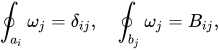
where  is the Riemann matrix of periods. The matrix belongs to the Siegel upper half space

The Riemann  function on
  corresponding to the period matrix is defined to be

Choose a point  , a local parameter
  in a neighbourhood of
  with
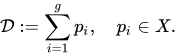
with  and a positive divisor of degree
For any positive integer  let
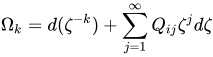
let  be the unique meromorphic differential of the second kind characterized by the following conditions:
- The only singularity of is a pole of order  at
at  with vanishing residue.
- The expansion of around is
 .
.
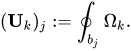
- is normalized to have vanishing  -cycles:

Denote by  the vector of
  -cycles of :
Denote the image of  under the Abel map

with arbitrary base point  .
.
Then the following is a KP -function:

Matrix model partition functions as KP -functionsEdit-functions of hypergeometric type. Generating function for Hurwitz numbersEditLet  be a (doubly) infinite sequence of complex numbers. For any integer partition define the content product coefficient
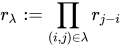
where the product is over all pairs  of positive integers that correspond to boxes of the Young diagram of the partition , viewed as positions of matrix elements of the corresponding
  matrix. Then, for every pair of infinite sequences and
  of complex vaiables, viewed as (normalized) power sums
 ![{\displaystyle \mathbf {t} =[\mathbf {x} ],\ \mathbf {s} =[\mathbf {y} ]}](https://wikimedia.org/api/rest_v1/media/math/render/svg/f2ae60caa223f2557d233989b00a69c4f6efc842) of the infinite sequence of auxiliary variables
of the infinite sequence of auxiliary variables  and
and  , defined by

the function
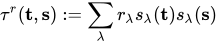
is a double KP -function, both in the  and the
  variables, known as a function of hypergeometric type.[9]
In particular, choosing
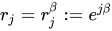
for some small parameter  , denoting the corresponding content product coefficient as
  and setting
  , the resulting -function can be equivalently expanded as
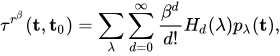 | | (7) |
where  are the simple Hurwitz numbers, which are
  times the number of ways in which an element
  of the symmetric group
  in
in  elements, with cycle lengths equal to the parts of the partition , can be factorized as a product of
 -cycles

and

is the power sum symmetric function. Equation (7) thus shows that the (formal) KP hypergeometric -function corresponding to the content product coefficients is a generating function, in the combinatorial sense, for simple Hurwitz numbers. [10][11