A two dimensional Minkowski space, i.e. a flat space with one time and one spatial dimension, has a two-dimensional Poincaré group IO(1,1) as its symmetry group. The respective Lie algebra is called the Poincaré algebra. It is possible to extend this algebra to a supersymmetry algebra, which is a  -graded Lie superalgebra. The most common ways to do this are discussed below.
 algebraEdit
Let the Lie algebra of IO(1,1) be generated by the following generators:
 is the generator of the time translation,
 is the generator of the space translation,
 is the generator of Lorentz boosts.
For the commutators between these generators, see Poincaré algebra.
The supersymmetry algebra over this space is a supersymmetric extension of this Lie algebra with the four additional generators (supercharges) 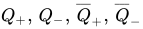 , which are odd elements of the Lie superalgebra. Under Lorentz transformations the generators
  and
and  transform as left-handed Weyl spinors, while
  and
and  transform as right-handed Weyl spinors. The algebra is given by the Poincaré algebra plus[1]:283
![{\displaystyle {\begin{aligned}&{\begin{aligned}&Q_{+}^{2}=Q_{-}^{2}={\overline {Q}}_{+}^{2}={\overline {Q}}_{-}^{2}=0,\\&\{Q_{\pm },{\overline {Q}}_{\pm }\}=H\pm P,\\\end{aligned}}\\&{\begin{aligned}&\{{\overline {Q}}_{+},{\overline {Q}}_{-}\}=Z,&&\{Q_{+},Q_{-}\}=Z^{*},\\&\{Q_{-},{\overline {Q}}_{+}\}={\tilde {Z}},&&\{Q_{+},{\overline {Q}}_{-}\}={\tilde {Z}}^{*},\\&{[iM,Q_{\pm }]}=\mp Q_{\pm },&&{[iM,{\overline {Q}}_{\pm }]}=\mp {\overline {Q}}_{\pm },\end{aligned}}\end{aligned}}}](https://wikimedia.org/api/rest_v1/media/math/render/svg/94a6c84a269429b5c95c06c46c4bb01968b61042)
where all remaining commutators vanish, and  and
and  are complex central charges. The supercharges are related via
  .
.  ,
,  , and
, and  are Hermitian.
Subalgebras of the algebraEditThe  and
and  subalgebrasEdit
The subalgebra is obtained from the algebra by removing the generators and . Thus its anti-commutation relations are given by[1]:289
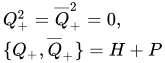
plus the commutation relations above that do not involve or . Both generators are left-handed Weyl spinors.
Similarly, the subalgebra is obtained by removing and and fulfills
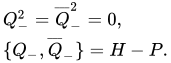
Both supercharge generators are right-handed.
The  subalgebraEdit
The subalgebra is generated by two generators  and
and  given by
 for two real numbers
  and
and  .
.
By definition, both supercharges are real, i.e. 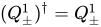 . They transform as Majorana-Weyl spinors under Lorentz transformations. Their anti-commutation relations are given by[1]:287
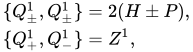
where  is a real central charge.
The  and
and  subalgebrasEdit
These algebras can be obtained from the subalgebra by removing resp. from the generators.