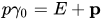
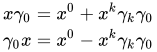
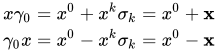
In mathematical physics, spacetime algebra (STA) is a name for the Clifford algebra Cl1,3(R), or equivalently the geometric algebra G(M4). According to David Hestenes, spacetime algebra can be particularly closely associated with the geometry of special relativity and relativistic spacetime.
It is a vector space that allows not only vectors, but also bivectors (directed quantities associated with particular planes, such as areas, or rotations) or blades (quantities associated with particular hyper-volumes) to be combined, as well as rotated, reflected, or Lorentz boosted. It is also the natural parent algebra of spinors in special relativity. These properties allow many of the most important equations in physics to be expressed in particularly simple forms, and can be very helpful towards a more geometric understanding of their meanings.
StructureEditThe spacetime algebra may be built up from an orthogonal basis of one time-like vector  and three space-like vectors,
  , with the multiplication rule

where  is the Minkowski metric with signature (+ − − −).
Thus,  ,
,  , otherwise
  .
.
The basis vectors  share these properties with the Dirac matrices, but no explicit matrix representation need be used in STA.
This generates a basis of one scalar  , four vectors
  , six bivectors
  , four pseudovectors
  and one pseudoscalar
  , where
 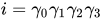 .
.
Reciprocal frameEditAssociated with the orthogonal basis  is the reciprocal basis
 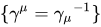 for
for  , satisfying the relation
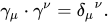
These reciprocal frame vectors differ only by a sign, with  , and
, and  for
for  .
.
A vector may be represented in either upper or lower index coordinates  with summation over , according to the Einstein notation, where the coordinates may be extracted by taking dot products with the basis vectors or their reciprocals.

Spacetime gradientEditThe spacetime gradient, like the gradient in a Euclidean space, is defined such that the directional derivative relationship is satisfied:

This requires the definition of the gradient to be
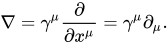
Written out explicitly with  , these partials are
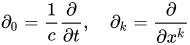
Spacetime splitEditMultivector divisionEditThe spacetime algebra is not a division algebra, because it contains idempotent elements  and nonzero zero divisors:
  . These can be interpreted as projectors onto the light-cone and orthogonality relations for such projectors, respectively. But in some cases it is possible to divide one multivector quantity by another, and make sense of the result: so, for example, a directed area divided by a vector in the same plane gives another vector, orthogonal to the first.
Spacetime algebra description of non-relativistic physicsEditNon-relativistic quantum mechanicsEdit
Spacetime algebra allows the description of the Pauli particle in terms of a real theory in place of a matrix theory. The matrix theory description of the Pauli particle is:[4]

where  is the imaginary unit with no geometric interpretation,
  are the Pauli matrices (with the 'hat' notation indicating that
  is a matrix operator and not an element in the geometric algebra), and
  is the Schrödinger Hamiltonian. In the spacetime algebra the Pauli particle is described by the real Pauli–Schrödinger equation:[4]

where now is the unit pseudoscalar  , and
, and  and
and  are elements of the geometric algebra, with an even multi-vector; is again the Schrödinger Hamiltonian. Hestenes refers to this as the real Pauli–Schrödinger theory to emphasize that this theory reduces to the Schrödinger theory if the term that includes the magnetic field is dropped.
Spacetime algebra description of relativistic physicsEditRelativistic quantum mechanicsEdit
The relativistic quantum wavefunction is sometimes expressed as a spinor field, i.e.[citation needed]
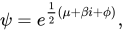
where  is a bivector, and[5][6]
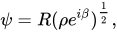
where, according to its derivation by David Hestenes,  is an even multivector-valued function on spacetime,
  is a unimodular spinor (or “rotor”[7]), and
  and
and  are scalar-valued functions.[5]
This equation is interpreted as connecting spin with the imaginary pseudoscalar.[8]  is viewed as a Lorentz rotation which a frame of vectors
  into another frame of vectors
  by the operation
  ,[7] where the tilde symbol indicates the reverse (the reverse is often also denoted by the dagger symbol, see also Rotations in geometric algebra).
This has been extended to provide a framework for locally varying vector- and scalar-valued observables and support for the Zitterbewegung interpretation of quantum mechanics originally proposed by Schrödinger.
Hestenes has compared his expression for with Feynman's expression for it in the path integral formulation:

where  is the classical action along the
  -path.[5]
Spacetime algebra enables a description of the Dirac particle in terms of a real theory in place of a matrix theory. The matrix theory description of the Dirac particle is:[9]

where  are the Dirac matrices. In the spacetime algebra the Dirac particle is described by the equation:[9]

Here, and are elements of the geometric algebra, and  is the spacetime vector derivative.
A new formulation of general relativityEdit
Lasenby, Doran, and Gull of Cambridge University have proposed a new formulation of gravity, termed gauge theory gravity (GTG), wherein spacetime algebra is used to induce curvature on Minkowski space while admitting a gauge symmetry under "arbitrary smooth remapping of events onto spacetime" (Lasenby, et al.); a nontrivial derivation then leads to the geodesic equation,
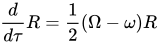
and the covariant derivative
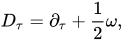
where  is the connection associated with the gravitational potential, and
  is an external interaction such as an electromagnetic field.
The theory shows some promise for the treatment of black holes, as its form of the Schwarzschild solution does not break down at singularities; most of the results of general relativity have been mathematically reproduced, and the relativistic formulation of classical electrodynamics has been extended to quantum mechanics and the Dirac equation.