In signal processing, the polynomial Wigner–Ville distribution is a quasiprobability distribution that generalizes the Wigner distribution function. It was proposed by Boualem Boashash and Peter O'Shea in 1994.
IntroductionEditMany signals in nature and in engineering applications can be modeled as 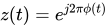 , where
  is a polynomial phase and
  .
.
For example, it is important to detect signals of an arbitrary high-order polynomial phase. However, the conventional Wigner–Ville distribution have the limitation being based on the second-order statistics. Hence, the polynomial Wigner–Ville distribution was proposed as a generalized form of the conventional Wigner–Ville distribution, which is able to deal with signals with nonlinear phase.
DefinitionEditThe polynomial Wigner–Ville distribution  is defined as
![W_{z}^{g}(t,f)={\mathcal {F}}_{{\tau \to f}}\left[K_{z}^{g}(t,\tau )\right]](https://wikimedia.org/api/rest_v1/media/math/render/svg/a740d196e07cf2ae7d81f00e326e7ed8ce43aa08)
where  denotes the Fourier transform with respect to
  , and
, and  is the polynomial kernel given by
![K_{z}^{g}(t,\tau )=\prod _{{k=-{\frac {q}{2}}}}^{{{\frac {q}{2}}}}\left[z\left(t+c_{k}\tau \right)\right]^{{b_{k}}}](https://wikimedia.org/api/rest_v1/media/math/render/svg/0f7d3fdb9c7a91fac5e8fbc10e27b6d4802797f2)
where  is the input signal and
  is an even number. The above expression for the kernel may be rewritten in symmetric form as
![K_{z}^{g}(t,\tau )=\prod _{{k=0}}^{{{\frac {q}{2}}}}\left[z\left(t+c_{k}\tau \right)\right]^{{b_{k}}}\left[z^{*}\left(t+c_{{-k}}\tau \right)\right]^{{-b_{{-k}}}}](https://wikimedia.org/api/rest_v1/media/math/render/svg/1349a5a121e3af6753817726a5187d0684752627)
The discrete-time version of the polynomial Wigner–Ville distribution is given by the discrete Fourier transform of
![K_{z}^{g}(n,m)=\prod _{{k=0}}^{{{\frac {q}{2}}}}\left[z\left(n+c_{{k}}m\right)\right]^{{b_{k}}}\left[z^{*}\left(n+c_{{-k}}m\right)\right]^{{-b_{{-k}}}}](https://wikimedia.org/api/rest_v1/media/math/render/svg/f6815fc858f5caadd88cb064cf2fb4e00a921ec4)
where  and
and  is the sampling frequency. The conventional Wigner–Ville distribution is a special case of the polynomial Wigner–Ville distribution with
ExampleEditOne of the simplest generalizations of the usual Wigner–Ville distribution kernel can be achieved by taking  . The set of coefficients
  and
and  must be found to completely specify the new kernel. For example, we set


The resulting discrete-time kernel is then given by
![K_{z}^{g}(n,m)=\left[z\left(n+0.675m\right)z^{*}\left(n-0.675m\right)\right]^{2}z^{*}\left(n+0.85m\right)z\left(n-0.85m\right)](https://wikimedia.org/api/rest_v1/media/math/render/svg/f028a0741b754b125535f840cc9c4473de3a42f0)
Design of a Practical Polynomial KernelEdit
Given a signal , where 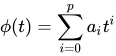 is a polynomial function, its instantaneous frequency (IF) is
 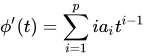 .
.
For a practical polynomial kernel , the set of coefficients  and should be chosen properly such that
![{\displaystyle {\begin{aligned}K_{z}^{g}(t,\tau )&=\prod _{k=0}^{\frac {q}{2}}\left[z\left(t+c_{k}\tau \right)\right]^{b_{k}}\left[z^{*}\left(t+c_{-k}\tau \right)\right]^{-b_{-k}}\\&=\exp(j2\pi \sum _{i=1}^{p}ia_{i}t^{i-1}\tau )\end{aligned}}}](https://wikimedia.org/api/rest_v1/media/math/render/svg/bdc320a0b85fe419e5a08f2c04779374f28f5a3b)
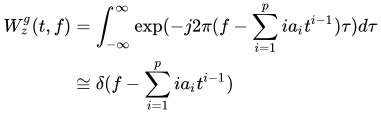
- When
 ,
,



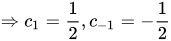
- When

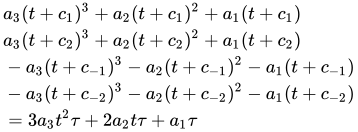
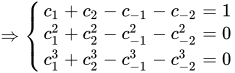
ApplicationsEditNonlinear FM signals are common both in nature and in engineering applications. For example, the sonar system of some bats use hyperbolic FM and quadratic FM signals for echo location. In radar, certain pulse-compression schemes employ linear FM and quadratic signals. The Wigner–Ville distribution has optimal concentration in the time-frequency plane for linear frequency modulated signals. However, for nonlinear frequency modulated signals, optimal concentration is not obtained, and smeared spectral representations result. The polynomial Wigner–Ville distribution can be designed to cope with such problem.