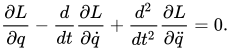
The main points of the proof can be made clearer by considering a one-dimensional system with a Lagrangian  . The Euler–Lagrange equation is
Non-degeneracy of  means that the canonical coordinates can be expressed in terms of the derivatives of
  and vice versa. Thus,
  is a function of
  (if it was not, the Jacobian
 ![{\displaystyle \det[\partial ^{2}L/(\partial {{\ddot {q}}_{i}}\,\partial {\ddot {q}}_{j})]}](https://wikimedia.org/api/rest_v1/media/math/render/svg/c04cc97e3726bce8e2d3ca5af421c18c0e8c7eb1) would vanish, which would mean that is degenerate), meaning that we can write
would vanish, which would mean that is degenerate), meaning that we can write  or, inverting,
  . Since the evolution of
  depends upon four initial parameters, this means that there are four canonical coordinates. We can write those as


and by using the definition of the conjugate momentum,
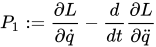

The above results can be obtained as follows. First, we rewrite the Lagrangian into "ordinary" form by introducing a Lagrangian multiplier as a new dynamic variable 
 ,
,
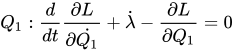
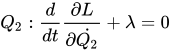
from which, the Euler-Lagrangian equations for  read
read
 ,
, ,
, ,
,
Now, the canonical momentum  with respect to
  are readily shown to be

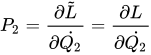
while

These are precisely the definitions given above by Ostrogradski. One may proceed further to evaluate the Hamiltonian
 ,
,
where one makes use of the above Euler-Lagrangian equations for the second equality. We note that due to non-degeneracy, we can write  as
as  . Here, only three arguments are needed since the Lagrangian itself only has three free parameters. Therefore, the last expression only depends on
  , it effectively serves as the Hamiltonian of the original theory, namely,
 .
.
We now notice that the Hamiltonian is linear in  . This is Ostrogradsky's instability, and it stems from the fact that the Lagrangian depends on fewer coordinates than there are canonical coordinates (which correspond to the initial parameters needed to specify the problem). The extension to higher dimensional systems is analogous, and the extension to higher derivatives simply means that the phase space is of even higher dimension than the configuration space, which exacerbates the instability (since the Hamiltonian is linear in even more canonical coordinates).