In many-body physics, the problem of analytic continuation is that of numerically extracting the spectral density of a Green function given its values on the imaginary axis. It is a necessary post-processing step for calculating dynamical properties of physical systems from quantum Monte Carlo simulations, which often compute Green function values only at imaginary-times or Matsubara frequencies.
Mathematically, the problem reduces to solving a Fredholm integral equation of the first kind with an ill-conditioned kernel. As a result, it is an ill-posed inverse problem with no unique solution and where a small noise on the input leads to large errors in the unregularized solution. There are different methods for solving this problem including the maximum entropy method.[1][2][3][4], the average spectrum method[5][6][7][8] and Pade approximation methods[9][10]
ExamplesEditA common analytic continuation problem is obtaining the spectral function  at real frequencies
  from the Green function values
  at Matsubara frequencies
  by numerically inverting the integral equation

where  for fermionic systems or
  for bosonic ones and
  is the inverse temperature. This relation is an example of Kramers-Kronig relation.
The spectral function can also be related to the imaginary-time Green function  be applying the inverse Fourier transform to the above equation

with ![{\textstyle \tau \in [0,\beta ]}](https://wikimedia.org/api/rest_v1/media/math/render/svg/b9f13118338d6e6778bcb1639a56c568f4d4a095) . Evaluating the summation over Matsubara frequencies gives the desired relation
. Evaluating the summation over Matsubara frequencies gives the desired relation
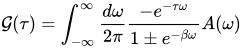
where the upper sign is for fermionic systems and the lower sign is for bosonic ones.
Another example of the analytic continuation is calculating the optical conductivity  from the current-current correlation function values
  at Matsubara frequencies. The two are related as following
