The Mehler kernel is a complex-valued function found to be the propagator of the quantum harmonic oscillator.
Mehler's formula
Mehler (1866) defined a function[1]

and showed, in modernized notation,[2] that it can be expanded in terms of Hermite polynomials H(.) based on weight function exp(−x²) as

This result is useful, in modified form, in quantum physics, probability theory, and harmonic analysis.
Physics version
In physics, the fundamental solution, (Green's function), or propagator of the Hamiltonian for the quantum harmonic oscillator is called the Mehler kernel. It provides the fundamental solution---the most general solution[3] φ(x,t) to
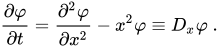
The orthonormal eigenfunctions of the operator D are the Hermite functions,
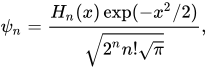
with corresponding eigenvalues (2n+1), furnishing particular solutions

The general solution is then a linear combination of these; when fitted to the initial condition φ(x,0), the general solution reduces to

where the kernel K has the separable representation

Utilizing Mehler's formula then yields

On substituting this in the expression for K with the value exp(−2t) for ρ, Mehler's kernel finally reads

When t = 0, variables x and y coincide, resulting in the limiting formula necessary by the initial condition,

As a fundamental solution, the kernel is additive,

This is further related to the symplectic rotation structure of the kernel K.[4]
Probability version
The result of Mehler can also be linked to probability. For this, the variables should be rescaled as x → x/√2, y → y/√2, so as to change from the 'physicist's' Hermite polynomials H(.) (with weight function exp(−x²)) to "probabilist's" Hermite polynomials He(.) (with weight function exp(−x²/2)). Then, E becomes

The left-hand side here is p(x,y)/p(x)p(y) where p(x,y) is the bivariate Gaussian probability density function for variables x,y having zero means and unit variances:

and p(x), p(y) are the corresponding probability densities of x and y (both standard normal).
There follows the usually quoted form of the result (Kibble 1945)[5]

This expansion is most easily derived by using the two-dimensional Fourier transform of p(x,y), which is

This may be expanded as

The Inverse Fourier transform then immediately yields the above expansion formula.
This result can be extended to the multidimensional case (Kibble 1945, Slepian 1972,[6] Hörmander 1985 [7]).
Fractional Fourier transform
Since Hermite functions ψn are orthonormal eigenfunctions of the Fourier transform,
=(-i)^{n}\psi _{n}(y)~,](https://wikimedia.org/api/rest_v1/media/math/render/svg/18fef130b65b78970374e39cbabcbf271b22d7e4)
in harmonic analysis and signal processing, they diagonalize the Fourier operator,
=\int dxf(x)\sum _{{n\geq 0}}(-i)^{n}\psi _{n}(x)\psi _{n}(y)~.](https://wikimedia.org/api/rest_v1/media/math/render/svg/cf3ea91402c790262f95baec52a351081245d48c)
Thus, the continuous generalization for real angle α can be readily defined (Wiener, 1929;[8] Condon, 1937[9]), the fractional Fourier transform (FrFT), with kernel

This is a continuous family of linear transforms generalizing the Fourier transform, such that, for α = π/2, it reduces to the standard Fourier transform, and for α = −π/2 to the inverse Fourier transform.
The Mehler formula, for ρ = exp(−iα), thus directly provides
={\sqrt {{\frac {1-i\cot(\alpha )}{2\pi }}}}~e^{{i{\frac {\cot(\alpha )}{2}}y^{2}}}\int _{{-\infty }}^{\infty }e^{{-i\left(\csc(\alpha )~yx-{\frac {\cot(\alpha )}{2}}x^{2}\right)}}f(x)\,{\mathrm {d}}x~.](https://wikimedia.org/api/rest_v1/media/math/render/svg/d01d9ea704d135d386380e64673d3cd0b2bd4aec)
The square root is defined such that the argument of the result lies in the interval [−π /2, π /2].
If α is an integer multiple of π, then the above cotangent and cosecant functions diverge. In the limit, the kernel goes to a Dirac delta function in the integrand, δ(x−y) or δ(x+y), for α an even or odd multiple of π, respectively. Since 

| This article uses material from the Wikipedia article Metasyntactic variable, which is released under the Creative Commons Attribution-ShareAlike 3.0 Unported License. |