In mathematics, the Liouville–Neumann series is an infinite series that corresponds to the resolvent formalism technique of solving the Fredholm integral equations in Fredholm theory.
Definition
The Liouville–Neumann (iterative) series is defined as
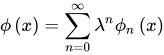
which, provided that 

If the nth iterated kernel is defined as n−1 nested integrals of n operators K,

then

with

so K0 may be taken to be δ(x−z).
The resolvent (or solving kernel for the integral operator) is then given by a schematic analog "geometric series",
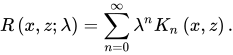
where K0 has been taken to be δ(x−z).
The solution of the integral equation thus becomes simply

Similar methods may be used to solve the Volterra equations.
| This article uses material from the Wikipedia article Metasyntactic variable, which is released under the Creative Commons Attribution-ShareAlike 3.0 Unported License. |