In mathematics, Legendre transform is an integral transform named after the mathematician Adrien-Marie Legendre, which uses Legendre polynomials  as kernels of the transform. Legendre transform is a special case of Jacobi transform.
The Legendre transform of a function  is[1][2][3]

The inverse Legendre transform is given by

Associated Legendre transformEditAssociated Legendre transform is defined as

The inverse Legendre transform is given by

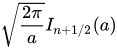
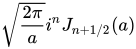
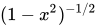
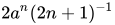
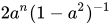
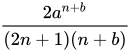
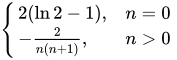
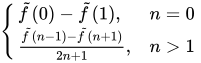
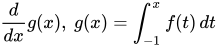
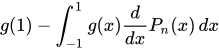
Some Legendre transform pairsEdit | |
|---|
 |  |
 |  |
 |  |
 | ![{\displaystyle {\frac {1}{2n+1}}[(n+1){\tilde {f}}(n+1)+n{\tilde {f}}(n-1)]}](https://wikimedia.org/api/rest_v1/media/math/render/svg/c9afd71e6b93976243febfa6bd4cf4bfe019f263) |
 |  |
![{\displaystyle [2(a-x)]^{-1}\,}](https://wikimedia.org/api/rest_v1/media/math/render/svg/c7ccab3887f776107d24e82a572792aa3c4e91af) |  |
 |  |
 |  |
 |  |
![{\displaystyle {\frac {d}{dx}}\left[(1-x^{2}){\frac {d}{dx}}\right]f(x)\,}](https://wikimedia.org/api/rest_v1/media/math/render/svg/48de115672b821258f92fe1b6f252b77526325a0) | 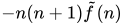 |
![{\displaystyle \left\{{\frac {d}{dx}}\left[(1-x^{2}){\frac {d}{dx}}\right]\right\}^{k}f(x)\,}](https://wikimedia.org/api/rest_v1/media/math/render/svg/aa0c542720c2a0c210fbd39959aa4e6e9b75b86a) |  |
![{\displaystyle {\frac {f(x)}{4}}-{\frac {d}{dx}}\left[(1-x^{2}){\frac {d}{dx}}\right]f(x)\,}](https://wikimedia.org/api/rest_v1/media/math/render/svg/284e0b487df466ca8050d215e4bfa19ac4e4c36b) | 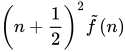 |
 |  |
 |  |
 |  |
 |  |