The Klein–Gordon equation (Klein–Fock–Gordon equation or sometimes Klein–Gordon–Fock equation) is a relativistic wave equation, related to the Schrödinger equation. It is second-order in space and time and manifestly Lorentz-covariant. It is a quantized version of the relativistic energy–momentum relation. Its solutions include a quantum scalar or pseudoscalar field, a field whose quanta are spinless particles. Its theoretical relevance is similar to that of the Dirac equation.[1] Electromagnetic interactions can be incorporated, forming the topic of scalar electrodynamics, but because common spinless particles like the pions are unstable and also experience the strong interaction (with unknown interaction term in the Hamiltonian,[2]) the practical utility is limited.
The equation can be put into the form of a Schrödinger equation. In this form it is expressed as two coupled differential equations, each of first order in time.[3] The solutions have two components, reflecting the charge degree of freedom in relativity.[3][4] It admits a conserved quantity, but this is not positive definite. The wave function cannot therefore be interpreted as a probability amplitude. The conserved quantity is instead interpreted as electric charge, and the norm squared of the wave function is interpreted as a charge density. The equation describes all spinless particles with positive, negative, and zero charge.
Any solution of the free Dirac equation is, component-wise, a solution of the free Klein–Gordon equation. The Klein–Gordon equation does not form the basis of a consistent quantum relativistic one-particle theory. There is no known such theory for particles of any spin. For full reconciliation of quantum mechanics with special relativity, quantum field theory is needed, in which the Klein–Gordon equation reemerges as the equation obeyed by the components of all free quantum fields.[nb 1] In quantum field theory, the solutions of the free (noninteracting) versions of the original equations still play a role. They are needed to build the Hilbert space (Fock space) and to express quantum fields by using complete sets (spanning sets of Hilbert space) of wave functions.
Statement
The Klein–Gordon equation with mass parameter 

Solutions of the equation are complex-valued functions 


The equation is often abbreviated as
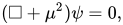
where μ = mc/ħ, and □ is the d'Alembert operator, defined by

(We are using the (−, +, +, +) metric signature.)
The Klein–Gordon equation is often written in natural units:
.
The form of the Klein–Gordon equation is derived by requiring that plane-wave solutions

of the equation obey the energy–momentum relation of special relativity:

Unlike the Schrödinger equation, the Klein–Gordon equation admits two values of ω for each k: one positive and one negative. Only by separating out the positive and negative frequency parts does one obtain an equation describing a relativistic wavefunction. For the time-independent case, the Klein–Gordon equation becomes
![{\displaystyle \left[\nabla ^{2}-{\frac {m^{2}c^{2}}{\hbar ^{2}}}\right]\psi (\mathbf {r} )=0,}](https://wikimedia.org/api/rest_v1/media/math/render/svg/80f9fbdaf1674535b7e1127f5bad0af593daeb98)
which is formally the same as the homogeneous screened Poisson equation.
History
The equation was named after the physicists Oskar Klein and Walter Gordon, who in 1926 proposed that it describes relativistic electrons. Other authors making similar claims in that same year were Vladimir Fock, Johann Kudar, Théophile de Donder and Frans-H. van den Dungen, and Louis de Broglie. Although it turned out that modeling the electron's spin required the Dirac equation, the Klein–Gordon equation correctly describes the spinless relativistic composite particles, like the pion. On 4 July 2012, European Organization for Nuclear Research CERN announced the discovery of the Higgs boson. Since the Higgs boson is a spin-zero particle, it is the first observed ostensibly elementary particle to be described by the Klein–Gordon equation. Further experimentation and analysis is required to discern whether the Higgs boson observed is that of the Standard Model or a more exotic, possibly composite, form.
The Klein–Gordon equation was first considered as a quantum wave equation by Schrödinger in his search for an equation describing de Broglie waves. The equation is found in his notebooks from late 1925, and he appears to have prepared a manuscript applying it to the hydrogen atom. Yet, because it fails to take into account the electron's spin, the equation predicts the hydrogen atom's fine structure incorrectly, including overestimating the overall magnitude of the splitting pattern by a factor of 4n2n − 1 for the n-th energy level. The Dirac equation relativistic spectrum is, however, easily recovered if the orbital-momentum quantum number l is replaced by total angular-momentum quantum number j.[5] In January 1926, Schrödinger submitted for publication instead his equation, a non-relativistic approximation that predicts the Bohr energy levels of hydrogen without fine structure.
In 1926, soon after the Schrödinger equation was introduced, Vladimir Fock wrote an article about its generalization for the case of magnetic fields, where forces were dependent on velocity, and independently derived this equation. Both Klein and Fock used Kaluza and Klein's method. Fock also determined the gauge theory for the wave equation. The Klein–Gordon equation for a free particle has a simple plane-wave solution.
Derivation
The non-relativistic equation for the energy of a free particle is

By quantizing this, we get the non-relativistic Schrödinger equation for a free particle:
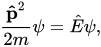
where

is the momentum operator (∇ being the del operator), and

is the energy operator.
The Schrödinger equation suffers from not being relativistically invariant, meaning that it is inconsistent with special relativity.
It is natural to try to use the identity from special relativity describing the energy:
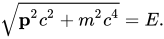
Then, just inserting the quantum-mechanical operators for momentum and energy yields the equation

The square root of a differential operator can be defined with the help of Fourier transformations, but due to the asymmetry of space and time derivatives, Dirac found it impossible to include external electromagnetic fields in a relativistically invariant way. So he looked for another equation that can be modified in order to describe the action of electromagnetic forces. In addition, this equation, as it stands, is nonlocal (see also Introduction to nonlocal equations).
Klein and Gordon instead began with the square of the above identity, i.e.

which, when quantized, gives

which simplifies to

Rearranging terms yields

Since all reference to imaginary numbers has been eliminated from this equation, it can be applied to fields that are real-valued, as well as those that have complex values.
Rewriting the first two terms using the inverse of the Minkowski metric diag(−c2, 1, 1, 1), and writing the Einstein summation convention explicitly we get

Thus the Klein–Gordon equation can be written in a covariant notation. This often means an abbreviation in the form of
where

and
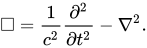
This operator is called the d'Alembert operator.
Today this form is interpreted as the relativistic field equation for spin-0 particles.[3] Furthermore, any component of any solution to the free Dirac equation (for a spin-1/2 particle) is automatically a solution to the free Klein–Gordon equation. This generalizes to particles of any spin due to the Bargmann–Wigner equations. Furthermore, in quantum field theory, every component of every quantum field must satisfy the free Klein–Gordon equation,[6] making the equation a generic expression of quantum fields.
Klein–Gordon equation in a potential
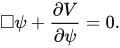
The Klein–Gordon equation can be generalized to describe a field in some potential V(ψ) as[7]
Conserved current
The conserved current associated to the U(1) symmetry of a complex field 

The form of the conserved current can be derived systematically by applying Noether's theorem to the U(1) symmetry. We will not do so here, but simply give a proof that this conserved current is correct.
From the Klein–Gordon equation for a complex field 

and its complex conjugate

we have, multiplying by the left respectively by 



Subtracting the former from the latter, we obtain


then we also know

from which we obtain the conservation law for the Klein–Gordon field:

Relativistic free particle solution
The Klein–Gordon equation for a free particle can be written as
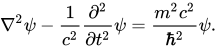
We look for plane-wave solutions of the form

for some constant angular frequency ω ∈ ℝ and wave number k ∈ ℝ3. Substitution gives the dispersion relation
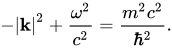
Energy and momentum are seen to be proportional to ω and k:


So the dispersion relation is just the classic relativistic equation:

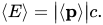
For massless particles, we may set m = 0, recovering the relationship between energy and momentum for massless particles:
Action
Non-relativistic limit
Classical field
Taking the non-relativistic limit (v << c) of a classical Klein-Gordon field ψ(x, t) begins with the ansatz factoring the oscillatory rest mass energy term,

Defining the kinetic energy 

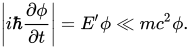
Applying this yields the non-relativistic limit of the second time derivative of 


Substituting into the free Klein–Gordon equation, 

which (by dividing out the exponential and subtracting the mass term) simplifies to
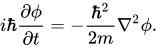
This is a classical Schrödinger field.
Quantum field
The analogous limit of a quantum Klein-Gordon field is complicated by the non-commutativity of the field operator. In the limit v << c, the creation and annihilation operators decouple and behave as independent quantum Schrödinger fields.
Electromagnetic interaction
There is a simple way to make any field interact with electromagnetism in a gauge-invariant way: replace the derivative operators with the gauge-covariant derivative operators. This is because to maintain symmetry of the physical equations for the wavefunction 







in natural units, where A is the vector potential. While it is possible to add many higher-order terms, for example,

these terms are not renormalizable in 3 + 1 dimensions.
The field equation for a charged scalar field multiplies by i,[clarification needed] which means that the field must be complex. In order for a field to be charged, it must have two components that can rotate into each other, the real and imaginary parts.
The action for a massless charged scalar is the covariant version of the uncharged action:

Gravitational interaction
In general relativity, we include the effect of gravity by replacing partial with covariant derivatives, and the Klein–Gordon equation becomes (in the mostly pluses signature)[8]
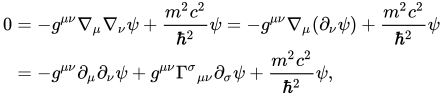
or equivalently,

where gαβ is the inverse of the metric tensor that is the gravitational potential field, g is the determinant of the metric tensor, ∇μ is the covariant derivative, and Γσμν is the Christoffel symbol that is the gravitational force field.
| This article uses material from the Wikipedia article Metasyntactic variable, which is released under the Creative Commons Attribution-ShareAlike 3.0 Unported License. |