A homoeoid is a shell (a bounded region) bounded by two concentric, similar ellipses (in 2D) or ellipsoids (in 3D).[1][2] When the thickness of the shell becomes negligible, it is called a thin homoeoid. The name homoeoid was coined by Lord Kelvin and Peter Tait.[3]

Cut view of a homoeoid in 3D
Mathematical definition
If the outer shell is given by
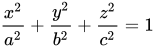
with semiaxes 

.
The thin homoeoid is then given by the limit

Physical meaning
A homoeoid can be used as a construction element of a matter or charge distribution. The gravitational or electromagnetic potential of a homoeoid homogeneously filled with matter or charge is constant inside the shell. This means that a test mass or charge will not feel any force inside the shell.[4]
| This article uses material from the Wikipedia article Metasyntactic variable, which is released under the Creative Commons Attribution-ShareAlike 3.0 Unported License. |