In mathematics, a Generalized Clifford algebra (GCA) is an associative algebra that generalizes the Clifford algebra, and goes back to the work of Hermann Weyl,[1] who utilized and formalized these clock-and-shift operators introduced by J. J. Sylvester (1882),[2] and organized by Cartan (1898)[3] and Schwinger.[4]
Clock and shift matrices find routine applications in numerous areas of mathematical physics, providing the cornerstone of quantum mechanical dynamics in finite-dimensional vector spaces.[5][6][7] The concept of a spinor can further be linked to these algebras.[6]
The term Generalized Clifford Algebras can also refer to associative algebras that are constructed using forms of higher degree instead of quadratic forms.[8][9][10][11]
Definition and properties
Abstract definition
The n-dimensional generalized Clifford algebra is defined as an associative algebra over a field F, generated by[12]
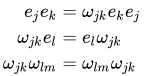
and

∀ j,k,l,m = 1,...,n.
Moreover, in any irreducible matrix representation, relevant for physical applications, it is required that

∀ j,k = 1,...,n, and 

More specific definition
In the more common cases of GCA,[6] the n-dimensional generalized Clifford algebra of order p has the property ωkj = ω, 

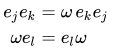
and

for all j,k,l = 1,...,n, and

is the pth root of 1.
There exist several definitions of a Generalized Clifford Algebra in the literature.[13]
- Clifford algebra
In the (orthogonal) Clifford algebra, the elements follow an anticommutation rule, with ω = −1, and p = 2.
Matrix representation
The Clock and Shift matrices can be represented[14] by n×n matrices in Schwinger's canonical notation as
.
Notably, Vn = 1, VU = ωUV (the Weyl braiding relations), and W−1VW = U (the discrete Fourier transform). With e1 = V , e2 = VU, and e3 = U, one has three basis elements which, together with ω, fulfil the above conditions of the Generalized Clifford Algebra (GCA).
These matrices, V and U, normally referred to as "shift and clock matrices", were introduced by J. J. Sylvester in the 1880s. (Note that the matrices V are cyclic permutation matrices that perform a circular shift; they are not to be confused with upper and lower shift matrices which have ones only either above or below the diagonal, respectively).
Specific examples
Case n = p = 2
In this case, we have ω = −1, and

thus
,
which constitute the Pauli matrices.
Case n = p = 4
In this case we have ω = i, and

and e1, e2, e3 may be determined accordingly.
| This article uses material from the Wikipedia article Metasyntactic variable, which is released under the Creative Commons Attribution-ShareAlike 3.0 Unported License. |