Although named after Enrico Fermi, most of the work leading to the "golden rule" is due to Paul Dirac, who formulated 20 years earlier a virtually identical equation, including the three components of a constant, the matrix element of the perturbation and an energy difference.[1][2] It was given this name because, on account of its importance, Fermi called it "golden rule No. 2".[3]
Most uses of the term Fermi's golden rule are referring to "golden rule No. 2", however, Fermi's "golden rule No. 1" is of a similar form and considers the probability of indirect transitions per unit time.[4]
Fermi's golden rule describes a system that begins in an eigenstate  of an unperturbed Hamiltonian H0 and considers the effect of a perturbing Hamiltonian H' applied to the system. If H' is time-independent, the system goes only into those states in the continuum that have the same energy as the initial state. If H' is oscillating sinusoidally as a function of time (i.e. it is a harmonic perturbation) with an angular frequency ω, the transition is into states with energies that differ by ħω from the energy of the initial state.
In both cases, the transition probability per unit of time from the initial state to a set of final states  is essentially constant. It is given, to first-order approximation, by

where  is the matrix element (in bra–ket notation) of the perturbation H' between the final and initial states, and
  is the density of states (number of continuum states divided by
  in the infinitesimally small energy interval
  to
to  ) at the energy
  of the final states. This transition probability is also called "decay probability" and is related to the inverse of the mean lifetime. Thus, the probability of finding the system in state is proportional to
  .
.
The standard way to derive the equation is to start with time-dependent perturbation theory and to take the limit for absorption under the assumption that the time of the measurement is much larger than the time needed for the transition.[5][6]
| Derivation in time-dependent perturbation theory | |
|---|
Main article: Perturbation theory (quantum mechanics) § Time-dependent perturbation theory Statement of the problemEditThe golden rule is a straightforward consequence of the Schrödinger equation, solved to lowest order in the perturbation H' of the Hamiltonian. The total Hamiltonian is the sum of an “original” Hamiltonian H0 and a perturbation: 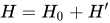 . In the interaction picture, we can expand an arbitrary quantum state’s time evolution in terms of energy eigenstates of the unperturbed system . In the interaction picture, we can expand an arbitrary quantum state’s time evolution in terms of energy eigenstates of the unperturbed system  , with , with  . . Discrete spectrum of final statesEditWe first consider the case where the final states are discrete. The expansion of a state in the perturbed system at a time t is  . The coefficients an(t) are yet unknown functions of time yielding the probability amplitudes in the Dirac picture. This state obeys the time-dependent Schrödinger equation: . The coefficients an(t) are yet unknown functions of time yielding the probability amplitudes in the Dirac picture. This state obeys the time-dependent Schrödinger equation: 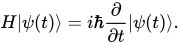
Expanding the Hamiltonian and the state, we see that, to first order,  where En and |n⟩ are the stationary eigenvalues and eigenfunctions of H0. where En and |n⟩ are the stationary eigenvalues and eigenfunctions of H0.
This equation can be rewritten as a system of differential equations specifying the time evolution of the coefficients  : : 
This equation is exact, but normally cannot be solved in practice. For a weak constant perturbation H' that turns on at t = 0, we can use perturbation theory. Namely, if  , it is evident that , it is evident that  , which simply says that the system stays in the initial state , which simply says that the system stays in the initial state  . . For states  , ,  becomes non-zero due to becomes non-zero due to  , and these are assumed to be small due to the weak perturbation. Hence, one can plug in the zeroth-order form into the above equation to get the first correction for the amplitudes : , and these are assumed to be small due to the weak perturbation. Hence, one can plug in the zeroth-order form into the above equation to get the first correction for the amplitudes : 
whose integral can be expressed via the identity  as as 
with  , for a state with ai(0) = 1, ak(0) = 0, transitioning to a state with ak(t) (again, ). This is the same as the generic result for the time evolution of any two-state system in a basis where the Hamiltonian is not diagonal. , for a state with ai(0) = 1, ak(0) = 0, transitioning to a state with ak(t) (again, ). This is the same as the generic result for the time evolution of any two-state system in a basis where the Hamiltonian is not diagonal. The transition rate is then 
a sinc function peaking sharply for small ω. At  , , 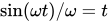 , so the transition rate varies linearly with t for an isolated state , so the transition rate varies linearly with t for an isolated state  ! ! Continuous spectrum of final statesEditBy dramatic contrast, for states of energy E embedded in a continuum, they must be all accounted for collectively. For a density of states per unit energy interval ρ(E), they must be integrated over their energies, and whence the corresponding ω values, 
For large t, the sinc function is sharply peaked at ω ≈ 0, so the density of states can be taken out of the integral. We also assume that the transition element can be approximated as a constant. The rate is then 
A change of variables shows that the integral is independent of t, the definite integral being π. The time dependence has vanished, and the constant decay rate of the golden rule follows.[7] As a constant, it underlies the exponential particle decay laws of radioactivity. (For excessively long times, however, the secular growth of the ak(t) terms invalidates lowest-order perturbation theory, which requires ak ≪ ai.) | |
Only the magnitude of the matrix element enters the Fermi's golden rule. The phase of this matrix element, however, contains separate information about the transition process. It appears in expressions that complement the golden rule in the semiclassical Boltzmann equation approach to electron transport.[8]
While the Golden rule is commonly stated and derived in the terms above, the final state (continuum) wave function is often rather vaguely described, and not normalized correctly (and the normalisation is used in the derivation). The problem is that in order to produce a continuum there can be no spatial confinement (which would necessarily discretise the spectrum), and therefore the continuum wave functions must have infinite extent, and in turn this means that the normalisation 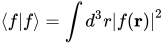 is infinite, not unity. If the interactions depend on the energy of the continuum state, but not any other quantum numbers, it is usual to normalise continuum wave-functions with energy
  labelled
  , by writing
  where
where  is the Dirac delta function, and effectively a factor of the square-root of the density of states is included into
  .[9] In this case, the continuum wave function has dimensions of
  [energy], and the Golden Rule is now
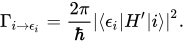
where  refers to the continuum state with the same energy as the discrete state . For example, correctly normalized continuum wave functions for the case of a free electron in the vicinity of a hydrogen atom are available in Bethe and Salpeter .[10]
| Normalized Derivation in time-dependent perturbation theory | |
|---|
Main article: Perturbation theory (quantum mechanics) § Time-dependent perturbation theory The following paraphrases the treatment of Cohen-Tannoudji.[9] As before, the total Hamiltonian is the sum of an “original” Hamiltonian H0 and a perturbation: . We can still expand an arbitrary quantum state’s time evolution in terms of energy eigenstates of the unperturbed system, but these now consist of discrete states and continuum states. We assume that the interactions depend on the energy of the continuum state, but not any other quantum numbers. The expansion in the relevant states in the Dirac picture is 
where  and and  are the energies of states are the energies of states  . The integral is over the continuum . The integral is over the continuum  , i.e. is in the continuum. , i.e. is in the continuum. Substituting into the time-dependent Schrödinger equation 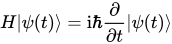
and premultiplying by  produces produces 
where  , and premultiplying by , and premultiplying by  produces produces 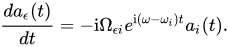
We made use of the normalisation  . Integrating the latter and substituting into the former, . Integrating the latter and substituting into the former, 
It can be seen here that  at time at time  depends on depends on  at all earlier times at all earlier times  , i.e. it is non-Markovian. We make the Markov approximation, i.e. that it only depends on at time (which is less restrictive than the approximation that ≈1 used above, and allows the perturbation to be strong) , i.e. it is non-Markovian. We make the Markov approximation, i.e. that it only depends on at time (which is less restrictive than the approximation that ≈1 used above, and allows the perturbation to be strong) 
where  and and  . Integrating over . Integrating over  , , 
The fraction on the right is a nascent Dirac delta function, meaning it tends to  as as  (ignoring its imaginary part which leads to an unimportant energy shift, while the real part produces decay [9]). Finally (ignoring its imaginary part which leads to an unimportant energy shift, while the real part produces decay [9]). Finally 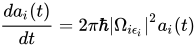
which has solutions  , i.e. the decay of population in the initial discrete state is , i.e. the decay of population in the initial discrete state is  where where 
| |
SemiconductorsEdit
The Fermi golden rule can be used for calculating the transition probability rate for an electron that is excited by a photon from the valence band to the conduction band in a direct band-gap semiconductor, and also for when the electron recombines with the hole and emits a photon.[11] Consider a photon of frequency  and wavevector
  , where the light dispersion relation is
 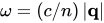 and
and  is the index of refraction.
Using the Coulomb gauge where  and
and  , the vector potential of the EM wave is given by
  where the resulting electric field is

For a charged particle in the valence band, the Hamiltonian is
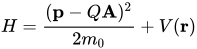
where  is the potential of the crystal. If our particle is an electron (
 ) and we consider process involving one photon and first order in
  . The resulting Hamiltonian is
![{\displaystyle H=H_{0}+H'=\left[{\frac {{\textbf {p}}^{2}}{2m_{0}}}+V({\textbf {r}})\right]+\left[{\frac {e}{2m_{0}}}({\textbf {p}}\cdot {\textbf {A}}+{\textbf {A}}\cdot {\textbf {p}})\right]}](https://wikimedia.org/api/rest_v1/media/math/render/svg/addf0cf147a399999b96b73b0f17732b3254dced)
where  is the perturbation of the EM wave.
From here on we have transition probability based on time-dependent perturbation theory that

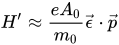
where  is the light polarization vector. From perturbation it is evident that the heart of the calculation lies in the matrix elements shown in the braket.
For the initial and final states in valence and conduction bands respectively, we have  and
and  , and if the operator does not act on the spin, the electron stays in the same spin state and hence we can write the wavefunctions as Bloch waves so
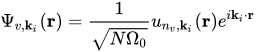

where  is the number of unit cells with volume
  . Using these wavefunctions and with some more mathematics, and focusing on emission (photoluminescence) rather than absorption, we are led to the transition rate

where  is the transition dipole moment matrix element is qualitatively the expectation value
  and in this situation takes the form

Finally, we want to know the total transition rate  . Hence we need to sum over all initial and final states (i.e. an integral of the Brillouin zone in the k-space), and take into account spin degeneracy, which through some mathematics results in

where  is the joint valence-conduction density of states (i.e. the density of pair of states; one occupied valence state, one empty conduction state). In 3D, this is

but the joint DOS is different for 2D, 1D, and 0D.
Finally we note that in a general way we can express the Fermi golden rule for semiconductors as[12]

Scanning tunneling microscopyEdit
Main article: Scanning tunneling microscope § Principle of operation
In a scanning tunneling microscope, the Fermi golden rule is used in deriving the tunneling current. It takes the form
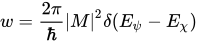
where  is the tunneling matrix element.
Quantum opticsEdit
When considering energy level transitions between two discrete states, Fermi's golden rule is written as

where  is the density of photon states at a given energy,
  is the photon energy, and is the angular frequency. This alternative expression relies on the fact that there is a continuum of final (photon) states, i.e. the range of allowed photon energies is continuous.[13]
Drexhage experimentEdit

Both the radiation pattern and the total emitted power (which is proportional to the decay rate) of a dipole depend on its distance from a mirror.
Fermi's golden rule predicts that the probability that an excited state will decay depends on the density of states. This can be seen experimentally by measuring the decay rate of a dipole near a mirror: as the presence of the mirror creates regions of higher and lower density of states, the measured decay rate depends on the distance between the mirror and the dipole.[14][15]