In mathematics (linear algebra), the Faddeev–LeVerrier algorithm is a recursive method to calculate the coefficients of the characteristic polynomial of a square matrix, A, named after Dmitry Konstantinovich Faddeev and Urbain Le Verrier. Calculation of this polynomial yields the eigenvalues of A as its roots; as a matrix polynomial in the matrix A itself, it vanishes by the fundamental Cayley–Hamilton theorem. Computing determinant from the definition of characteristic polynomial, however, is computationally cumbersome, because is new symbolic quantity, whereas this algorithm works directly with coefficients of matrix .



The discoverer of Neptune.
The algorithm has been independently rediscovered several times, in some form or another. It was first published in 1840 by Urbain Le Verrier, subsequently redeveloped by P. Horst, Jean-Marie Souriau, in its present form here by Faddeev and Sominsky, and further by J. S. Frame, and others.[1][2][3][4][5] (For historical points, see Householder.[6] An elegant shortcut to the proof, bypassing Newton polynomials, was introduced by Hou.[7] The bulk of the presentation here follows Gantmacher, p. 88.[8])
The Algorithm
The objective is to calculate the coefficients ck of the characteristic polynomial of the n×n matrix A,
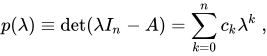
where, evidently, cn = 1 and c0 = (−1)n det A.
The coefficients are determined recursively from the top down, by dint of the auxiliary matrices M,

Thus,




etc.,[9][10] ...;
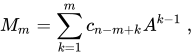

Observe A−1 = − Mn /c0 = (−1)n−1Mn/detA terminates the recursion at λ. This could be used to obtain the inverse or the determinant of A.
Derivation
The proof relies on the modes of the adjugate matrix, Bk ≡ Mn−k, the auxiliary matrices encountered. This matrix is defined by

and is thus proportional to the resolvent

It is evidently a matrix polynomial in λ of degree n−1. Thus,
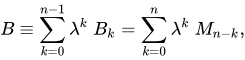
where one may define the harmless M0≡0.
Inserting the explicit polynomial forms into the defining equation for the adjugate, above,

Now, at the highest order, the first term vanishes by M0=0; whereas at the bottom order (constant in λ, from the defining equation of the adjugate, above),

so that shifting the dummy indices of the first term yields

which thus dictates the recursion

for m=1,...,n. Note that ascending index amounts to descending in powers of λ, but the polynomial coefficients c are yet to be determined in terms of the Ms and A.
This can be easiest achieved through the following auxiliary equation (Hou, 1998),

This is but the trace of the defining equation for B by dint of Jacobi's formula,

Inserting the polynomial mode forms in this auxiliary equation yields

so that
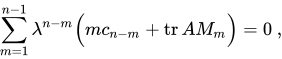
and finally

This completes the recursion of the previous section, unfolding in descending powers of λ.
Further note in the algorithm that, more directly,

and, in comportance with the Cayley–Hamilton theorem,

The final solution might be more conveniently expressed in terms of complete exponential Bell polynomials as

Example
![{\displaystyle {\displaystyle A=\left[{\begin{array}{rrr}3&1&5\\3&3&1\\4&6&4\end{array}}\right]}}](https://wikimedia.org/api/rest_v1/media/math/render/svg/4a23cfdb69eb826865d3072075b17bad2eb66200)
![{\displaystyle {\displaystyle {\begin{aligned}M_{0}&=\left[{\begin{array}{rrr}0&0&0\\0&0&0\\0&0&0\end{array}}\right]\quad &&&c_{3}&&&&&=&1\\M_{\mathbf {\color {blue}1} }&=\left[{\begin{array}{rrr}1&0&0\\0&1&0\\0&0&1\end{array}}\right]&A~M_{1}&=\left[{\begin{array}{rrr}\mathbf {\color {red}3} &1&5\\3&\mathbf {\color {red}3} &1\\4&6&\mathbf {\color {red}4} \end{array}}\right]&c_{2}&&&=-{\frac {1}{\mathbf {\color {blue}1} }}\mathbf {\color {red}10} &&=&-10\\M_{\mathbf {\color {blue}2} }&=\left[{\begin{array}{rrr}-7&1&5\\3&-7&1\\4&6&-6\end{array}}\right]\qquad &A~M_{2}&=\left[{\begin{array}{rrr}\mathbf {\color {red}2} &26&-14\\-8&\mathbf {\color {red}-12} &12\\6&-14&\mathbf {\color {red}2} \end{array}}\right]\qquad &c_{1}&&&=-{\frac {1}{\mathbf {\color {blue}2} }}\mathbf {\color {red}(-8)} &&=&4\\M_{\mathbf {\color {blue}3} }&=\left[{\begin{array}{rrr}6&26&-14\\-8&-8&12\\6&-14&6\end{array}}\right]\qquad &A~M_{3}&=\left[{\begin{array}{rrr}\mathbf {\color {red}40} &0&0\\0&\mathbf {\color {red}40} &0\\0&0&\mathbf {\color {red}40} \end{array}}\right]\qquad &c_{0}&&&=-{\frac {1}{\mathbf {\color {blue}3} }}\mathbf {\color {red}120} &&=&-40\end{aligned}}}}](https://wikimedia.org/api/rest_v1/media/math/render/svg/7fa5cc6fd02037d69ce3d4fa21722e16e4ff3f31)
Furthermore, 
The characteristic polynomial of matrix A is thus 

.
An equivalent but distinct expression
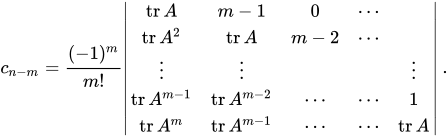
A compact determinant of an m×m-matrix solution for the above Jacobi's formula may alternatively determine the coefficients c,[11][12]
This article uses material from the Wikipedia article
Metasyntactic variable, which is released under the
Creative Commons
Attribution-ShareAlike 3.0 Unported License.
Metasyntactic variable, which is released under the
Creative Commons
Attribution-ShareAlike 3.0 Unported License.