The Ehrenfest theorem, named after Paul Ehrenfest, an Austrian theoretical physicist at Leiden University, relates the time derivative of the expectation values of the position and momentum operators x and p to the expectation value of the force on a massive particle moving in a scalar potential ,[1]



Although, at first glance, it might appear that the Ehrenfest theorem is saying that the quantum mechanical expectation values obey Newton’s classical equations of motion, this is not actually the case.[2] If the pair were to satisfy Newton's second law, the right-hand side of the second equation would have to be


which is typically not the same as

If for example, the potential is cubic, (i.e. proportional to ), then is quadratic (proportional to ). This means, in the case of Newton's second law, the right side would be in the form of , while in the Ehrenfest theorem it is in the form of . The difference between these two quantities is the square of the uncertainty in and is therefore nonzero.


An exception occurs in case when the classical equations of motion are linear, that is, when is quadratic and is linear. In that special case, and do agree. Thus, for the case of a quantum harmonic oscillator, the expected position and expected momentum do exactly follow the classical trajectories.


For general systems, if the wave function is highly concentrated around a point , then and will be almost the same, since both will be approximately equal to . In that case, the expected position and expected momentum will approximately follow the classical trajectories, at least for as long as the wave function remains localized in position.[3]


The Ehrenfest theorem is a special case of a more general relation between the expectation of any quantum mechanical operator and the expectation of the commutator of that operator with the Hamiltonian of the system [4][5]
![{\frac {d}{dt}}\langle A\rangle ={\frac {1}{i\hbar }}\langle [A,H]\rangle +\left\langle {\frac {\partial A}{\partial t}}\right\rangle ~,](https://wikimedia.org/api/rest_v1/media/math/render/svg/303dcdd57e0f1e0a9683a06fb1c2f764197c0d26)
where A is some quantum mechanical operator and ⟨A⟩ is its expectation value. This more general theorem was not actually derived by Ehrenfest (it is due to Werner Heisenberg).[citation needed]
It is most apparent in the Heisenberg picture of quantum mechanics, where it is just the expectation value of the Heisenberg equation of motion. It provides mathematical support to the correspondence principle.
The reason is that Ehrenfest's theorem is closely related to Liouville's theorem of Hamiltonian mechanics, which involves the Poisson bracket instead of a commutator. Dirac's rule of thumb suggests that statements in quantum mechanics which contain a commutator correspond to statements in classical mechanics where the commutator is supplanted by a Poisson bracket multiplied by iħ. This makes the operator expectation values obey corresponding classical equations of motion, provided the Hamiltonian is at most quadratic in the coordinates and momenta. Otherwise, the evolution equations still may hold approximately, provided fluctuations are small.
Derivation in the Schrödinger picture
Suppose some system is presently in a quantum state Φ. If we want to know the instantaneous time derivative of the expectation value of A, that is, by definition
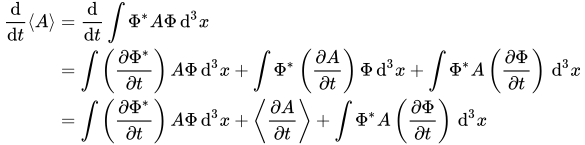
where we are integrating over all of space. If we apply the Schrödinger equation, we find that
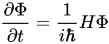
By taking the complex conjugate we find
[6]
Note H = H ∗, because the Hamiltonian is Hermitian. Placing this into the above equation we have
![{\displaystyle {\frac {d}{dt}}\langle A\rangle ={\frac {1}{i\hbar }}\int \Phi ^{*}(AH-HA)\Phi ~d^{3}x+\left\langle {\frac {\partial A}{\partial t}}\right\rangle ={\frac {1}{i\hbar }}\langle [A,H]\rangle +\left\langle {\frac {\partial A}{\partial t}}\right\rangle .}](https://wikimedia.org/api/rest_v1/media/math/render/svg/d1f00ea01ef7a2b29ad7544b22369195652c58b9)
Often (but not always) the operator A is time-independent so that its derivative is zero and we can ignore the last term.
Derivation in the Heisenberg picture
In the Heisenberg picture, the derivation is trivial. The Heisenberg picture moves the time dependence of the system to operators instead of state vectors. Starting with the Heisenberg equation of motion
![{\frac {d}{dt}}A(t)={\frac {\partial A(t)}{\partial t}}+{\frac {1}{i\hbar }}[A(t),H],](https://wikimedia.org/api/rest_v1/media/math/render/svg/82b9aa5e08a24dcd88b124df320196a634a5cf61)
we can derive Ehrenfest's theorem simply by projecting the Heisenberg equation onto 

![{\displaystyle \left\langle \Psi \left|{\frac {d}{dt}}A(t)\right|\Psi \right\rangle =\left\langle \Psi \left|{\frac {\partial A(t)}{\partial t}}\right|\Psi \right\rangle +\left\langle \Psi \left|{\frac {1}{i\hbar }}[A(t),H]\right|\Psi \right\rangle ,}](https://wikimedia.org/api/rest_v1/media/math/render/svg/f7b5c7c880e7301afdaf19b5828f551bbd9dfc55)
We can pull the ddt out of the first term since the state vectors are no longer time dependent in the Heisenberg Picture. Therefore,
![{\displaystyle {\frac {d}{dt}}\langle A(t)\rangle =\left\langle {\frac {\partial A(t)}{\partial t}}\right\rangle +{\frac {1}{i\hbar }}\left\langle [A(t),H]\right\rangle }](https://wikimedia.org/api/rest_v1/media/math/render/svg/df98436a1dd2bbc9c1ad5d9be45a8d87e654d43e)
General example
The expectation values of the theorem, however, are the very same in the Schrödinger picture as well. For the very general example of a massive particle moving in a potential, the Hamiltonian is simply
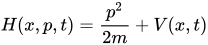
where x is the position of the particle.
Suppose we wanted to know the instantaneous change in the expectation of the momentum p. Using Ehrenfest's theorem, we have
![{\displaystyle {\frac {d}{dt}}\langle p\rangle ={\frac {1}{i\hbar }}\langle [p,H]\rangle +\left\langle {\frac {\partial p}{\partial t}}\right\rangle ={\frac {1}{i\hbar }}\langle [p,V(x,t)]\rangle ,}](https://wikimedia.org/api/rest_v1/media/math/render/svg/e314255a33c84294179b07e7d37f52583f210010)
since the operator p commutes with itself and has no time dependence.[7] By expanding the right-hand-side, replacing p by −iħ∇, we get

After applying the product rule on the second term, we have
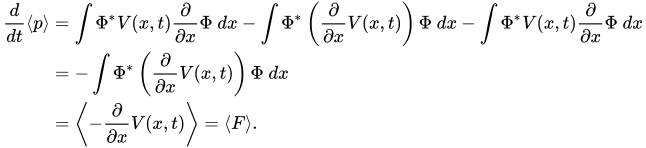
As explained in the introduction, this result does not say that the pair 


Similarly, we can obtain the instantaneous change in the position expectation value.
![{\displaystyle {\begin{aligned}{\frac {d}{dt}}\langle x\rangle &={\frac {1}{i\hbar }}\langle [x,H]\rangle +\left\langle {\frac {\partial x}{\partial t}}\right\rangle \\[5pt]&={\frac {1}{i\hbar }}\left\langle \left[x,{\frac {p^{2}}{2m}}+V(x,t)\right]\right\rangle +0\\[5pt]&={\frac {1}{i\hbar }}\left\langle \left[x,{\frac {p^{2}}{2m}}\right]\right\rangle \\[5pt]&={\frac {1}{i\hbar 2m}}\left\langle [x,p]{\frac {d}{dp}}p^{2}\right\rangle \\[5pt]&={\frac {1}{i\hbar 2m}}\langle i\hbar 2p\rangle \\[5pt]&={\frac {1}{m}}\langle p\rangle \end{aligned}}}](https://wikimedia.org/api/rest_v1/media/math/render/svg/3e5b47a274ca180f57ede2f4b4916058cd27e08f)
This result is actually in exact accord with the classical equation.
Derivation of the Schrödinger equation from the Ehrenfest theorems
It was established above that the Ehrenfest theorems are consequences of the Schrödinger equation. However, the converse is also true: the Schrödinger equation can be inferred from the Ehrenfest theorems.[8] We begin from
![{\displaystyle {\begin{aligned}m{\frac {d}{dt}}\left\langle \Psi (t)\right|{\hat {x}}\left|\Psi (t)\right\rangle &=\left\langle \Psi (t)\right|{\hat {p}}\left|\Psi (t)\right\rangle ,\\[5pt]{\frac {d}{dt}}\left\langle \Psi (t)\right|{\hat {p}}\left|\Psi (t)\right\rangle &=\left\langle \Psi (t)\right|-V'({\hat {x}})\left|\Psi (t)\right\rangle .\end{aligned}}}](https://wikimedia.org/api/rest_v1/media/math/render/svg/5ea29c13d0cbe58ff2000dc979d938942c2ee3de)
Application of the product rule leads to
![{\displaystyle {\begin{aligned}\left\langle {\frac {d\Psi }{dt}}{\Big |}{\hat {x}}{\Big |}\Psi \right\rangle +\left\langle \Psi {\Big |}{\hat {x}}{\Big |}{\frac {d\Psi }{dt}}\right\rangle &=\left\langle \Psi {\Big |}{\frac {\hat {p}}{m}}{\Big |}\Psi \right\rangle ,\\[5pt]\left\langle {\frac {d\Psi }{dt}}{\Big |}{\hat {p}}{\Big |}\Psi \right\rangle +\left\langle \Psi {\Big |}{\hat {p}}{\Big |}{\frac {d\Psi }{dt}}\right\rangle &=\langle \Psi |-V'({\hat {x}})|\Psi \rangle ,\end{aligned}}}](https://wikimedia.org/api/rest_v1/media/math/render/svg/219a9a4edd81e2f997d83aeff3b90c23ac1b71eb)
Here, apply Stone's theorem, using Ĥ to denote the quantum generator of time translation. The next step is to show that this is the same as the Hamiltonian operator used in quantum mechanics. Stone's theorem implies
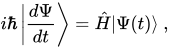
where ħ was introduced as a normalization constant to the balance dimensionality. Since these identities must be valid for any initial state, the averaging can be dropped and the system of commutator equations for Ĥ are derived:
![im[{\hat {H}},{\hat {x}}]=\hbar {\hat {p}},\qquad i[{\hat {H}},{\hat {p}}]=-\hbar V'({\hat {x}}).](https://wikimedia.org/api/rest_v1/media/math/render/svg/5a2449926ade577a5a42281524c6c3b83bf4178f)
Assuming that observables of the coordinate and momentum obey the canonical commutation relation [x̂, p̂] = iħ. Setting 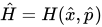

whose solution is the familiar quantum Hamiltonian
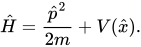
Whence, the Schrödinger equation was derived from the Ehrenfest theorems by assuming the canonical commutation relation between the coordinate and momentum. If one assumes that the coordinate and momentum commute, the same computational method leads to the Koopman–von Neumann classical mechanics, which is the Hilbert space formulation of classical mechanics.[8] Therefore, this derivation as well as the derivation of the Koopman–von Neumann mechanics, shows that the essential difference between quantum and classical mechanics reduces to the value of the commutator [x̂, p̂].
The implications of the Ehrenfest theorem for systems with classically chaotic dynamics are discussed at Scholarpedia article Ehrenfest time and chaos. Due to exponential instability of classical trajectories the Ehrenfest time, on which there is a complete correspondence between quantum and classical evolution, is shown to be logarithmically short being proportional to a logarithm of typical quantum number. For the case of integrable dynamics this time scale is much larger being proportional to a certain power of quantum number.
| This article uses material from the Wikipedia article Metasyntactic variable, which is released under the Creative Commons Attribution-ShareAlike 3.0 Unported License. |