Laplace transformEdit
Let  be a function defined whenever
  . Then its Laplace transform is given by

if the integral exists.[3]
A property of the Laplace transform useful for evaluating improper integrals is
![{\displaystyle {\mathcal {L}}{\Biggl [}{\frac {f(t)}{t}}{\Biggl ]}=\int _{s}^{\infty }F(u)\,du,}](https://wikimedia.org/api/rest_v1/media/math/render/svg/66fff46756a7edac8307549707d9f413ac0f53df)
provided  exists.
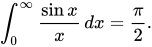
One may use this property to evaluate the Dirichlet integral as follows:
![{\displaystyle {\begin{aligned}\int _{0}^{\infty }{\frac {\sin t}{t}}\,dt&=\lim _{s\rightarrow 0}\int _{0}^{\infty }e^{-st}{\frac {\sin t}{t}}\,dt=\lim _{s\rightarrow 0}{\mathcal {L}}{\Biggl [}{\frac {\sin t}{t}}{\Biggl ]}\\[6pt]&=\lim _{s\rightarrow 0}\int _{s}^{\infty }{\frac {du}{u^{2}+1}}=\lim _{s\rightarrow 0}\arctan u{\Biggl |}_{s}^{\infty }\\[6pt]&=\lim _{s\rightarrow 0}{\Biggl [}{\frac {\pi }{2}}-\arctan(s){\Biggl ]}={\frac {\pi }{2}},\end{aligned}}}](https://wikimedia.org/api/rest_v1/media/math/render/svg/087fdbd7c8ad1815865692f6237d767a132e5813)
because 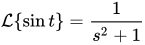 is the Laplace transform of the function
  . (See the section 'Differentiating under the integral sign' for a derivation.)
Double integrationEdit
Evaluating the Dirichlet integral using the Laplace transform is equivalent to attempting to evaluate the same double definite integral in two different ways, by reversal of the order of integration, namely:


Differentiation under the integral sign (Feynman's trick)Edit
First rewrite the integral as a function of the additional variable  . Let
. Let
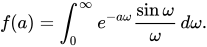
In order to evaluate the Dirichlet integral, we need to determine .
.
Differentiate with respect to and apply the Leibniz rule for differentiating under the integral sign to obtain
![{\displaystyle {\begin{aligned}{\frac {df}{da}}&={\frac {d}{da}}\int _{0}^{\infty }e^{-a\omega }{\frac {\sin \omega }{\omega }}\,d\omega =\int _{0}^{\infty }{\frac {\partial }{\partial a}}e^{-a\omega }{\frac {\sin \omega }{\omega }}\,d\omega \\[6pt]&=-\int _{0}^{\infty }e^{-a\omega }\sin \omega \,d\omega .\end{aligned}}}](https://wikimedia.org/api/rest_v1/media/math/render/svg/a326d9dd43130ca585938a8f5cf0d56cc00bddd6)
Now, using Euler's formula  one can express a sinusoid in terms of complex exponential functions. We thus have
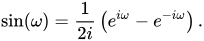
Therefore,
![{\displaystyle {\begin{aligned}{\frac {df}{da}}&=-\int _{0}^{\infty }e^{-a\omega }\sin \omega \,d\omega =-\int _{0}^{\infty }e^{-a\omega }{\frac {e^{i\omega }-e^{-i\omega }}{2i}}d\omega \\[6pt]&=-{\frac {1}{2i}}\int _{0}^{\infty }\left[e^{-\omega (a-i)}-e^{-\omega (a+i)}\right]d\omega \\[6pt]&=-{\frac {1}{2i}}\left[{\frac {-1}{a-i}}e^{-\omega (a-i)}-{\frac {-1}{a+i}}e^{-\omega (a+i)}\right]{\Biggl |}_{0}^{\infty }\\[6pt]&=-{\frac {1}{2i}}\left[0-\left({\frac {-1}{a-i}}+{\frac {1}{a+i}}\right)\right]=-{\frac {1}{2i}}\left({\frac {1}{a-i}}-{\frac {1}{a+i}}\right)\\[6pt]&=-{\frac {1}{2i}}\left({\frac {a+i-(a-i)}{a^{2}+1}}\right)=-{\frac {1}{a^{2}+1}}.\end{aligned}}}](https://wikimedia.org/api/rest_v1/media/math/render/svg/19bd4fb620b10d7461e78f0c6bf25beaf46ae666)
Integrating with respect to gives

where  is a constant of integration to be determined. Since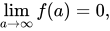
 using the principal value. This means
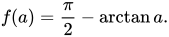
Finally, for  , we have
  , as before.
Complex integrationEdit
The same result can be obtained by complex integration. Consider

As a function of the complex variable  , it has a simple pole at the origin, which prevents the application of Jordan's lemma, whose other hypotheses are satisfied.
Define then a new function[4]
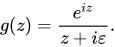
The pole has been moved away from the real axis, so  can be integrated along the semicircle of radius
  centered at
  and closed on the real axis. One then takes the limit
  .
.
The complex integral is zero by the residue theorem, as there are no poles inside the integration path

The second term vanishes as goes to infinity. As for the first integral, one can use one version of the Sokhotski–Plemelj theorem for integrals over the real line: for a complex-valued function f defined and continuously differentiable on the real line and real constants and  with
with  one finds

where  denotes the Cauchy principal value. Back to the above original calculation, one can write
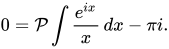
By taking the imaginary part on both sides and noting that the function  is even, we get

Finally,

Alternatively, choose as the integration contour for  the union of upper half-plane semicircles of radii
  and together with two segments of the real line that connect them. On one hand the contour integral is zero, independently of and ; on the other hand, as
  and
and  the integral's imaginary part converges to
  (here
(here  is any branch of logarithm on upper half-plane), leading to
  .
.
Dirichlet kernelEdit
Let
![{\displaystyle D_{n}(x)=1+2\sum _{k=1}^{n}\cos(2kx)={\frac {\sin[(2n+1)x]}{\sin(x)}}}](https://wikimedia.org/api/rest_v1/media/math/render/svg/98f41fa5b14e77747344cf23ec785e99a203c85d)
be the Dirichlet kernel.[5]
It immediately follows that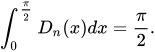
Define
![{\displaystyle f(x)={\begin{cases}{\frac {1}{x}}-{\frac {1}{\sin(x)}}&x\neq 0\\[6pt]0&x=0\end{cases}}}](https://wikimedia.org/api/rest_v1/media/math/render/svg/7f64c7164e4e85f01c167bd9a2581af7c0b77c16)
Clearly, is continuous when  , to see its continuity at 0 apply L'Hopital's Rule:

Hence, fulfills the requirements of the Riemann-Lebesgue Lemma. This means

(The form of the Riemann-Lebesgue Lemma used here is proven in the article cited.)
Choose limits and  . We would like to say that
![{\displaystyle {\begin{aligned}\int _{0}^{\infty }{\frac {\sin(t)}{t}}dt=&\lim _{\lambda \to \infty }\int _{0}^{\lambda {\frac {\pi }{2}}}{\frac {\sin(t)}{t}}dt\\[6pt]=&\lim _{\lambda \to \infty }\int _{0}^{\frac {\pi }{2}}{\frac {\sin(\lambda x)}{x}}dx\\[6pt]=&\lim _{\lambda \to \infty }\int _{0}^{\frac {\pi }{2}}{\frac {\sin(\lambda x)}{\sin(x)}}dx\\[6pt]=&\lim _{n\to \infty }\int _{0}^{\frac {\pi }{2}}{\frac {\sin((2n+1)x)}{\sin(x)}}dx\\[6pt]=&\lim _{n\to \infty }\int _{0}^{\frac {\pi }{2}}D_{n}(x)dx={\frac {\pi }{2}}\end{aligned}}}](https://wikimedia.org/api/rest_v1/media/math/render/svg/0e6c0b31854bcf1126b31ff7c151e9d32e4c646b)
In order to do so, however, we must justify switching the real limit in  to the integral limit in
  . This is in fact justified if we can show the limit does exist, which we do now.
Using integration by parts, we have:

Now, as  and
and  the term on the left converges with no problem. See the list of limits of trigonometric functions. We now show that
 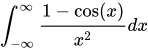 is absolutely integrable, which implies that the limit exists.[6]
First, we seek to bound the integral near the origin. Using the Taylor-series expansion of the cosine about zero,

Therefore,

Splitting the integral into pieces, we have

for some constant  . This shows that the integral is absolutely integrable, which implies the original integral exists, and switching from to was in fact justified, and the proof is complete.