In mathematics and quantum mechanics, a Dirac operator is a differential operator that is a formal square root, or half-iterate, of a second-order operator such as a Laplacian. The original case which concerned Paul Dirac was to factorise formally an operator for Minkowski space, to get a form of quantum theory compatible with special relativity; to get the relevant Laplacian as a product of first-order operators he introduced spinors.
Formal definition
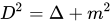
In general, let D be a first-order differential operator acting on a vector bundle V over a Riemannian manifold M. If

where ∆ is the Laplacian of V, then D is called a Dirac operator.
In high-energy physics, this requirement is often relaxed: only the second-order part of D2 must equal the Laplacian.
Examples
Example 1
D = −i ∂x is a Dirac operator on the tangent bundle over a line.
Example 2
Consider a simple bundle of notable importance in physics: the configuration space of a particle with spin 12 confined to a plane, which is also the base manifold. It is represented by a wavefunction ψ : R2 → C2
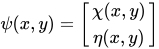
where x and y are the usual coordinate functions on R2. χ specifies the probability amplitude for the particle to be in the spin-up state, and similarly for η. The so-called spin-Dirac operator can then be written

where σi are the Pauli matrices. Note that the anticommutation relations for the Pauli matrices make the proof of the above defining property trivial. Those relations define the notion of a Clifford algebra.
Solutions to the Dirac equation for spinor fields are often called harmonic spinors.[1]
Example 3
Feynman's Dirac operator describes the propagation of a free fermion in three dimensions and is elegantly written

using the Feynman slash notation. In introductory textbooks to quantum field theory, this will appear in the form

where 



Example 4
Another Dirac operator arises in Clifford analysis. In euclidean n-space this is
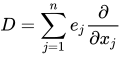
where {ej: j = 1, ..., n} is an orthonormal basis for euclidean n-space, and Rn is considered to be embedded in a Clifford algebra.
This is a special case of the Atiyah–Singer–Dirac operator acting on sections of a spinor bundle.
Example 5
For a spin manifold, M, the Atiyah–Singer–Dirac operator is locally defined as follows: For x ∈ M and e1(x), ..., ej(x) a local orthonormal basis for the tangent space of M at x, the Atiyah–Singer–Dirac operator is
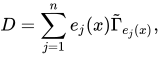
where 


Generalisations
In Clifford analysis, the operator D : C∞(Rk ⊗ Rn, S) → C∞(Rk ⊗ Rn, Ck ⊗ S) acting on spinor valued functions defined by
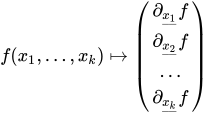
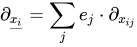
is sometimes called Dirac operator in k Clifford variables. In the notation, S is the space of spinors, 
| This article uses material from the Wikipedia article Metasyntactic variable, which is released under the Creative Commons Attribution-ShareAlike 3.0 Unported License. |