In quantum mechanics, the canonical commutation relation is the fundamental relation between canonical conjugate quantities (quantities which are related by definition such that one is the Fourier transform of another). For example,
![[{\hat x},{\hat p}_{x}]=i\hbar](https://wikimedia.org/api/rest_v1/media/math/render/svg/0b381467bfc81a02730bc71641cb995e1937703c)
between the position operator x and momentum operator px in the x direction of a point particle in one dimension, where [x , px] = x px − px x is the commutator of x and px , i is the imaginary unit, and ℏ is the reduced Planck's constant h/2π . In general, position and momentum are vectors of operators and their commutation relation between different components of position and momentum can be expressed as
![{\displaystyle [{\hat {r}}_{i},{\hat {p}}_{j}]=i\hbar \delta _{ij}.}](https://wikimedia.org/api/rest_v1/media/math/render/svg/eb862c1f183d0fcf43c841924c5c8605a0a5547c)
where is the Kronecker delta.

This relation is attributed to Max Born (1925),[1] who called it a "quantum condition" serving as a postulate of the theory; it was noted by E. Kennard (1927)[2] to imply the Heisenberg uncertainty principle. The Stone–von Neumann theorem gives a uniqueness result for operators satisfying (an exponentiated form of) the canonical commutation relation.
Relation to classical mechanics
By contrast, in classical physics, all observables commute and the commutator would be zero. However, an analogous relation exists, which is obtained by replacing the commutator with the Poisson bracket multiplied by iℏ,

This observation led Dirac to propose that the quantum counterparts f̂, ĝ of classical observables f, g satisfy
![[\hat f,\hat g]= i\hbar\widehat{\{f,g\}} \, .](https://wikimedia.org/api/rest_v1/media/math/render/svg/3793c6bacffce22601dac9acf78a8d8462b16acf)
In 1946, Hip Groenewold demonstrated that a general systematic correspondence between quantum commutators and Poisson brackets could not hold consistently.[3][4]
However, he further appreciated that such a systematic correspondence does, in fact, exist between the quantum commutator and a deformation of the Poisson bracket, today called the Moyal bracket, and, in general, quantum operators and classical observables and distributions in phase space. He thus finally elucidated the consistent correspondence mechanism, the Wigner–Weyl transform, that underlies an alternate equivalent mathematical representation of quantum mechanics known as deformation quantization.[3][5]
Derivation from Hamiltonian mechanics
According to the correspondence principle, in certain limits the quantum equations of states must approach Hamilton's equations of motion. The latter state the following relation between the generalized coordinate q (e.g. position) and the generalized momentum p:
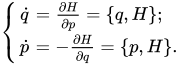
In quantum mechanics the Hamiltonian 


The time derivative of a quantum state is 
![{\displaystyle {\frac {d{\hat {Q}}}{dt}}={\frac {i}{\hbar }}[{\hat {H}},{\hat {Q}}]}](https://wikimedia.org/api/rest_v1/media/math/render/svg/8d03b2828a9705763864ec89adc470ea2ffa5916)
![{\displaystyle {\frac {d{\hat {P}}}{dt}}={\frac {i}{\hbar }}[{\hat {H}},{\hat {P}}]\,\,.}](https://wikimedia.org/api/rest_v1/media/math/render/svg/1e921ea2e87f770314b623c397e72fa9acae9e5a)
In order for that to reconcile in the classical limit with Hamilton's equations of motion, ![{\displaystyle [{\hat {H}},{\hat {Q}}]}](https://wikimedia.org/api/rest_v1/media/math/render/svg/e1c13d58f6e254c05d28a13d6dea93c8ccfda00f)
![{\displaystyle [{\hat {H}},{\hat {P}}]}](https://wikimedia.org/api/rest_v1/media/math/render/svg/a59c96abe77a8214e36c7b0f48a9c7beb91cbd4e)
![{\displaystyle [{\hat {H}},{\hat {Q}}]={\frac {\delta {\hat {H}}}{\delta {\hat {P}}}}\cdot [{\hat {P}},{\hat {Q}}]}](https://wikimedia.org/api/rest_v1/media/math/render/svg/0a4779e4c14205ebfa46840fc125d393d35c3d64)
![{\displaystyle [{\hat {H}},{\hat {P}}]={\frac {\delta {\hat {H}}}{\delta {\hat {Q}}}}\cdot [{\hat {Q}},{\hat {P}}]\,\,.}](https://wikimedia.org/api/rest_v1/media/math/render/svg/4420a20ace9e496791dedbf3608454063f4ff36f)
In order to get the classical limit we then must have:
![{\displaystyle [{\hat {Q}},{\hat {P}}]=i\hbar }](https://wikimedia.org/api/rest_v1/media/math/render/svg/1bf9acb1f6a278d6e61ec0d93463280363713435)
The Weyl relations
The group 
![[{\hat {x}},{\hat {p}}]=i\hbar](https://wikimedia.org/api/rest_v1/media/math/render/svg/42dbbd0db710385288536bcf4f4a1b7cceb75d9a)

According to the standard mathematical formulation of quantum mechanics, quantum observables such as 


Alternately, if ![{\displaystyle [{\hat {x}}^{n},{\hat {p}}]=i\hbar n{\hat {x}}^{n-1}}](https://wikimedia.org/api/rest_v1/media/math/render/svg/63bcc601af9c7a3054e923037db2248928991fed)
, so that, for any n,

However, n can be arbitrarily large, so at least one operator cannot be bounded, and the dimension of the underlying Hilbert space cannot be finite. If the operators satisfy the Weyl relations (an exponentiated version of the canonical commutation relations, described below) then as a consequence of the Stone–von Neumann theorem, both operators must be unbounded.
Still, these canonical commutation relations can be rendered somewhat "tamer" by writing them in terms of the (bounded) unitary operators 

.
These relations may be thought of as an exponentiated version of the canonical commutation relations; they reflect that translations in position and translations in momentum do not commute. One can easily reformulate the Weyl relations in terms of the representations of the Heisenberg group.
The uniqueness of the canonical commutation relations—in the form of the Weyl relations—is then guaranteed by the Stone–von Neumann theorem.
It is important to note that for technical reasons, the Weyl relations are not strictly equivalent to the canonical commutation relation
A discrete version of the Weyl relations, in which the parameters s and t range over 
Generalizations
The simple formula
![[x,p] = i\hbar, \,](https://wikimedia.org/api/rest_v1/media/math/render/svg/c2c5a39d7453d7d9e4b90f3c0df1ea1dfc575259)
valid for the quantization of the simplest classical system, can be generalized to the case of an arbitrary Lagrangian 
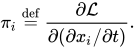
This definition of the canonical momentum ensures that one of the Euler–Lagrange equations has the form
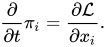
The canonical commutation relations then amount to
![[x_i,\pi_j] = i\hbar\delta_{ij}, \,](https://wikimedia.org/api/rest_v1/media/math/render/svg/fcf9753035bcd641c5d8750862201af2c1561020)
where δij is the Kronecker delta.
Further, it can be easily shown that
![{\displaystyle [F({\vec {x}}),p_{i}]=i\hbar {\frac {\partial F({\vec {x}})}{\partial x_{i}}};\qquad [x_{i},F({\vec {p}})]=i\hbar {\frac {\partial F({\vec {p}})}{\partial p_{i}}}.}](https://wikimedia.org/api/rest_v1/media/math/render/svg/945c49ff83f1564df126e9b6ec4df620c193205f)
Using 
![{\displaystyle \left[{\hat {x}}^{n},{\hat {p}}^{m}\right]=\sum _{k=1}^{min\left(m,n\right)}{{\frac {-\left(-i\hbar \right)^{k}n!m!}{k!\left(n-k\right)!\left(m-k\right)!}}{\hat {x}}^{n-k}{\hat {p}}^{m-k}}=\sum _{k=1}^{min\left(m,n\right)}{{\frac {\left(i\hbar \right)^{k}n!m!}{k!\left(n-k\right)!\left(m-k\right)!}}{\hat {p}}^{m-k}{\hat {x}}^{n-k}},}](https://wikimedia.org/api/rest_v1/media/math/render/svg/99df22b86a27ccc7f9aa0d089d0ac0154d4a65c3)
generally known as Mc Coy's formula.[10]
Gauge invariance
Canonical quantization is applied, by definition, on canonical coordinates. However, in the presence of an electromagnetic field, the canonical momentum p is not gauge invariant. The correct gauge-invariant momentum (or "kinetic momentum") is
(SI units)
(cgs units),
where q is the particle's electric charge, A is the vector potential, and c is the speed of light. Although the quantity pkin is the "physical momentum", in that it is the quantity to be identified with momentum in laboratory experiments, it does not satisfy the canonical commutation relations; only the canonical momentum does that. This can be seen as follows.
The non-relativistic Hamiltonian for a quantized charged particle of mass m in a classical electromagnetic field is (in cgs units)
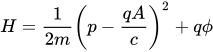
where A is the three-vector potential and φ is the scalar potential. This form of the Hamiltonian, as well as the Schrödinger equation Hψ = iħ∂ψ/∂t, the Maxwell equations and the Lorentz force law are invariant under the gauge transformation

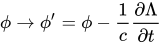
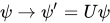

where
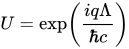
and Λ=Λ(x,t) is the gauge function.
The angular momentum operator is

and obeys the canonical quantization relations
![[L_i, L_j]= i\hbar {\epsilon_{ijk}} L_k](https://wikimedia.org/api/rest_v1/media/math/render/svg/163dfdb14c8096b5b7c4e5d71107fbaab7ecfe18)
defining the Lie algebra for so(3), where 

The gauge-invariant angular momentum (or "kinetic angular momentum") is given by
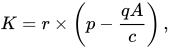
which has the commutation relations
![[K_i,K_j]=i\hbar {\epsilon_{ij}}^{\,k}
\left(K_k+\frac{q\hbar}{c} x_k
\left(x \cdot B\right)\right)](https://wikimedia.org/api/rest_v1/media/math/render/svg/f5649c0f538fb17bce5423dd761abd0899c9f216)
where

is the magnetic field. The inequivalence of these two formulations shows up in the Zeeman effect and the Aharonov–Bohm effect.
Uncertainty relation and commutators
All such nontrivial commutation relations for pairs of operators lead to corresponding uncertainty relations,[11] involving positive semi-definite expectation contributions by their respective commutators and anticommutators. In general, for two Hermitian operators A and B, consider expectation values in a system in the state ψ, the variances around the corresponding expectation values being (ΔA)2 ≡ ⟨(A − ⟨A⟩)2⟩, etc.
Then
![\Delta A \, \Delta B \geq \frac{1}{2} \sqrt{ \left|\left\langle\left[{A},{B}\right]\right\rangle \right|^2 + \left|\left\langle\left\{ A-\langle A\rangle ,B-\langle B\rangle \right\} \right\rangle \right|^2} ,](https://wikimedia.org/api/rest_v1/media/math/render/svg/7ff8bd2caaa29e16e902ee5be7951a8ec5ee3d69)
where [A, B] ≡ A B − B A is the commutator of A and B, and {A, B} ≡ A B + B A is the anticommutator.
This follows through use of the Cauchy–Schwarz inequality, since |⟨A2⟩| |⟨B2⟩| ≥ |⟨A B⟩|2, and A B = ([A, B] + {A, B})/2 ; and similarly for the shifted operators A − ⟨A⟩ and B − ⟨B⟩. (Cf. uncertainty principle derivations.)
Substituting for A and B (and taking care with the analysis) yield Heisenberg's familiar uncertainty relation for x and p, as usual.
Uncertainty relation for angular momentum operators
For the angular momentum operators Lx = y pz − z py, etc., one has that
![[{L_x}, {L_y}] = i \hbar \epsilon_{xyz} {L_z},](https://wikimedia.org/api/rest_v1/media/math/render/svg/94e8c32d52f5f09e8fee02ebda3ad0e2254b51ed)
where 
Here, for Lx and Ly ,[11] in angular momentum multiplets ψ = |ℓ,m⟩, one has, for the transverse components of the Casimir invariant Lx2 + Ly2+ Lz2, the z-symmetric relations
- ⟨Lx2⟩ = ⟨Ly2⟩ = (ℓ (ℓ + 1) − m2) ℏ2/2 ,
as well as ⟨Lx⟩ = ⟨Ly⟩ = 0 .
Consequently, the above inequality applied to this commutation relation specifies

hence
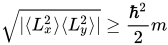
and therefore

so, then, it yields useful constraints such as a lower bound on the Casimir invariant: ℓ (ℓ + 1) ≥ m (m + 1), and hence ℓ ≥ m, among others.
| This article uses material from the Wikipedia article Metasyntactic variable, which is released under the Creative Commons Attribution-ShareAlike 3.0 Unported License. |