In mathematical physics, the Berezin integral, named after Felix Berezin, (also known as Grassmann integral, after Hermann Grassmann), is a way to define integration for functions of Grassmann variables (elements of the exterior algebra). It is not an integral in the Lebesgue sense; the word "integral" is used because the Berezin integral has properties analogous to the Lebesgue integral and because it extends the path integral in physics, where it is used as a sum over histories for fermions.
DefinitionEditLet  be the exterior algebra of polynomials in anticommuting elements
  over the field of complex numbers. (The ordering of the generators is fixed and defines the orientation of the exterior algebra.)
One variableEdit
The Berezin integral over the sole Grassmann variable  is defined to be a linear functional
![{\displaystyle \int [af(\theta )+bg(\theta )]\,d\theta =a\int f(\theta )\,d\theta +b\int g(\theta )\,d\theta ,\quad a,b\in \mathbb {C} }](https://wikimedia.org/api/rest_v1/media/math/render/svg/dfde6f43fd064d134ee25d8450d979cf470a806b)
where we define
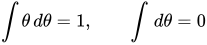
so that :

These properties define the integral uniquely and imply

Take note that  is the most general function of
  because Grassmann variables square to zero, so
  cannot have non-zero terms beyond linear order.
Multiple variablesEdit
The Berezin integral on is defined to be the unique linear functional  with the following properties:
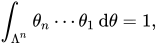
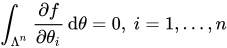
for any  where
where  means the left or the right partial derivative. These properties define the integral uniquely.
Notice that different conventions exist in the literature: Some authors define instead[1]
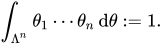
The formula

expresses the Fubini law. On the right-hand side, the interior integral of a monomial  is set to be
  where
where  ; the integral of
  vanishes. The integral with respect to
  is calculated in the similar way and so on.
Change of Grassmann variablesEdit
Let  be odd polynomials in some antisymmetric variables
  . The Jacobian is the matrix
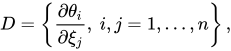
where  refers to the right derivative (
 ). The formula for the coordinate change reads

Integrating even and odd variablesEditDefinitionEdit
Consider now the algebra  of functions of real commuting variables
  and of anticommuting variables
  (which is called the free superalgebra of dimension
  ). Intuitively, a function
  is a function of m even (bosonic, commuting) variables and of n odd (fermionic, anti-commuting) variables. More formally, an element is a function of the argument
  that varies in an open set
  with values in the algebra
  Suppose that this function is continuous and vanishes in the complement of a compact set
  The Berezin integral is the number

Change of even and odd variablesEdit
Let a coordinate transformation be given by  where
where  are even and
  are odd polynomials of
  depending on even variables
  The Jacobian matrix of this transformation has the block form:
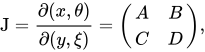
where each even derivative  commutes with all elements of the algebra ; the odd derivatives commute with even elements and anticommute with odd elements. The entries of the diagonal blocks
  and
and  are even and the entries of the off-diagonal blocks
  are odd functions, where again mean right derivatives.
We now need the Berezinian (or superdeterminant) of the matrix  , which is the even function

defined when the function  is invertible in
  Suppose that the real functions
 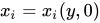 define a smooth invertible map
  of open sets
  in
in  and the linear part of the map
  is invertible for each
  The general transformation law for the Berezin integral reads

where  ) is the sign of the orientation of the map
  The superposition
  is defined in the obvious way, if the functions
  do not depend on
  In the general case, we write
  where
where  are even nilpotent elements of and set

where the Taylor series is finite.
Useful formulasEditThe following formulas for Gaussian integrals are used often in the path integral formulation of quantum field theory:
![\int \exp\left[-\theta^TA\eta\right] \,d\theta\,d\eta = \det A](https://wikimedia.org/api/rest_v1/media/math/render/svg/ba4f6563185d27aab329b97494db9484d51e56c6)
with  being a complex
  matrix.
![{\displaystyle \int \exp \left[-{\tfrac {1}{2}}\theta ^{T}M\theta \right]\,d\theta ={\begin{cases}\mathrm {Pf} \,M&n{\mbox{ even}}\\0&n{\mbox{ odd}}\end{cases}}}](https://wikimedia.org/api/rest_v1/media/math/render/svg/8b1eecdb5c568bb4224a2267d800f2d61b1a7460)
with  being a complex skew-symmetric matrix, and
  being the Pfaffian of , which fulfills
  .
.
In the above formulas the notation  is used. From these formulas, other useful formulas follow (See Appendix A in[2]) :
![{\displaystyle \int \exp \left[\theta ^{T}A\eta +\theta ^{T}J+K^{T}\eta \right]\,d\eta _{1}\,d\theta _{1}\dots d\eta _{n}d\theta _{n}=\det A\,\,\exp[-K^{T}A^{-1}J]}](https://wikimedia.org/api/rest_v1/media/math/render/svg/0a92463b08e9a8124c63104743c23a7e6d71f399)
with being an invertible matrix. Note that these integrals are all in the form of a partition function.
HistoryEditThe mathematical theory of the integral with commuting and anticommuting variables was invented and developed by Felix Berezin.[3] Some important earlier insights were made by David John Candlin[4] in 1956. Other authors contributed to these developments, including the physicists Khalatnikov[5] (although his paper contains mistakes), Matthews and Salam,[6] and Martin.[7]
LiteratureEdit- Theodore Voronov: Geometric integration theory on Supermanifolds, Harwood Academic Publisher, ISBN 3-7186-5199-8
- Berezin, Felix Alexandrovich: Introduction to Superanalysis, Springer Netherlands, ISBN 978-90-277-1668-2